

BRICS leaders called for “maximum restraint” in the Middle East and warned of growing nuclear dangers as the bloc adopted its New Delhi Declaration amid intensifying conflict involving Iran and the United States.
The joint declaration expressed “deep concern over the continued escalation of tensions in Middle East/West Asia” and urged members to work to keep global trade, supply chains and energy flows moving. It also issued a pointed warning over attacks on civilian infrastructure and peaceful nuclear facilities under International Atomic Energy Agency safeguards, saying nuclear safeguards, safety and security “must always be upheld, including in armed conflicts.”
The summit brought Iranian President Masoud Pezeshkian and Abu Dhabi Crown Prince Sheikh Khaled bin Mohamed bin Zayed Al Nahyan into the same diplomatic setting as the conflict placed BRICS’ internal divisions under pressure. It also gave Indian Prime Minister Narendra Modi an opportunity to engage separately with Chinese President Xi Jinping and Russian President Vladimir Putin as New Delhi sought to balance relations with rival major powers.
BRICS leaders in New Delhi called for “maximum restraint” over rising tensions in the Middle East, while urging protection of civilian infrastructure & peaceful nuclear facilities. The bloc called for smooth flow of global trade, supply chains & energy. https://t.co/ureMGWuTEC pic.twitter.com/drenmGukBN
— IRIA (@IRIA_Research) September 13, 2026
The declaration’s language was deliberately broad on the Middle East, avoiding direct attribution to individual countries. But its references to nuclear facilities, energy security, civilian infrastructure and global shipping underline the scale of the risks confronting the bloc.
The 11-member BRICS alliance now comprises Brazil, China, Egypt, Ethiopia, India, Indonesia, Iran, Russia, Saudi Arabia, South Africa and the United Arab Emirates. The expanded grouping brings together major emerging economies as well as states with sharply different positions on the Middle East conflict, creating a difficult test for consensus diplomacy.
BRICS calls for “maximum restraint” in Middle East
The Middle East dominated the security dimension of the summit.
BRICS leaders said they were deeply concerned about the continuing escalation in West Asia and called for “maximum restraint” and avoidance of actions that could further aggravate the situation.
They urged greater use of dialogue and diplomacy and stressed the protection of civilians and civilian infrastructure, while emphasizing respect for national sovereignty and territorial integrity.
The declaration also connects the conflict to the wider global economy, calling for efforts to maintain the “smooth flow of global trade, supply chains and energy” in accordance with international law.
That concern is particularly acute as the fighting has disrupted energy markets and maritime trade and raised the prospect of wider economic consequences beyond the region.
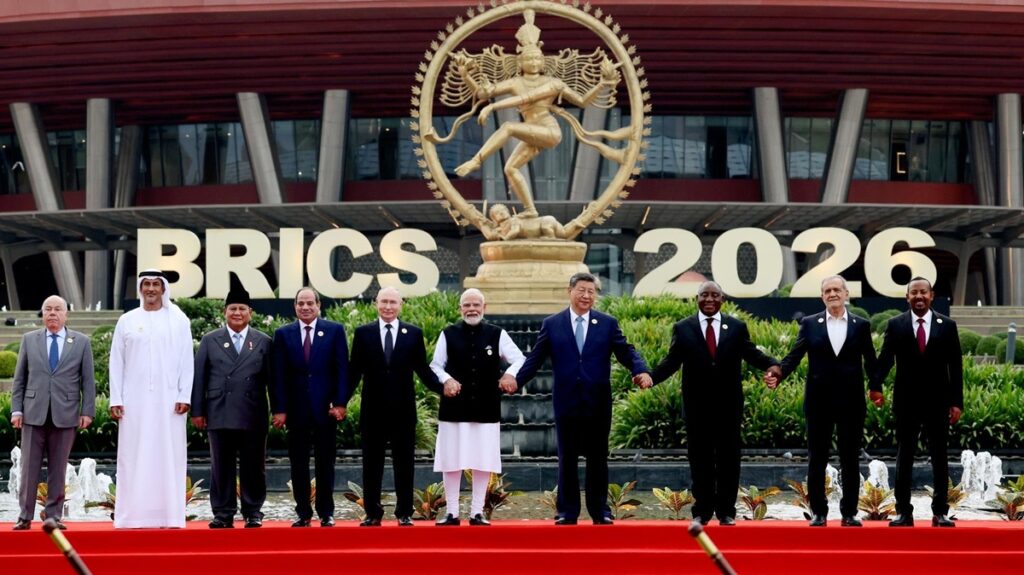
Chinese President Xi Jinping also warned of the broader consequences of the conflict. “As the situation in the Middle East and the Gulf region continues to evolve, the war there has caused serious losses to people across the region,” Xinhua quoted Xi as saying.
It “does not serve the common interests of the international community”, Xi said.
Nuclear facilities become a central security concern
The strongest security language in the declaration concerns nuclear risks.
BRICS leaders expressed “serious concern over deliberate attacks on civilian infrastructure and peaceful nuclear facilities under full safeguards of the International Atomic Energy Agency (IAEA), in violation of international law and relevant resolutions of the IAEA.”
They stressed that “Nuclear safeguards, safety, and security must always be upheld, including in armed conflicts, to protect people and the environment from harm.”
The declaration separately states that BRICS is concerned about “the growing risks of nuclear danger and conflict.”
The leaders called for renewed efforts on disarmament, arms control and non-proliferation and reiterated support for nuclear-weapon-free zones.
They also highlighted the long-standing proposal for a zone free of nuclear weapons and other weapons of mass destruction in the Middle East.
The nuclear language is significant because it places the protection of safeguarded nuclear facilities within the broader BRICS response to the Middle East conflict rather than treating nuclear safety solely as a technical or energy issue.
Gaza remains part of the wider regional agenda
The declaration also addresses the Gaza conflict, expressing “deep concern” over continued violence despite the October 2025 ceasefire agreement.
BRICS called for maintaining the ceasefire and ensuring “full and unhindered humanitarian access” to Gaza.
The leaders opposed policies aimed at the forced displacement of Palestinians from Gaza and expressed concern over arrangements that could prejudice the rights of Palestinians or legitimize or prolong occupation.
The bloc reiterated support for a two-state solution based on the internationally recognized 1967 borders, with East Jerusalem as the capital of a sovereign Palestinian state, and backed full UN membership for Palestine.
Iran and UAE leaders meet in New Delhi
One of the summit’s most closely watched encounters came on Sept. 12, when Iranian President Masoud Pezeshkian met Sheikh Khaled bin Mohamed bin Zayed Al Nahyan, the Crown Prince of Abu Dhabi.
The meeting brought together leaders from two countries whose interests have been pulled into opposite sides of the regional conflict.
Iran and the UAE also backed the BRICS declaration calling for restraint, a development that Reuters described as a sign of diplomatic progress between the two countries.
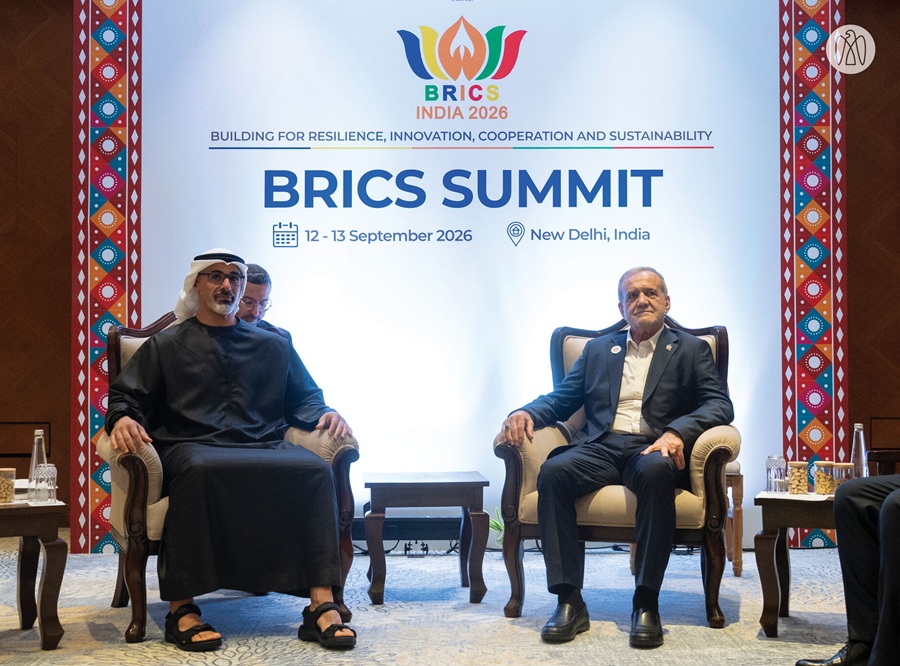
The Abu Dhabi media office said the leaders discussed regional and international issues, “along with the importance of supporting de-escalation efforts, reducing tensions, and achieving stability in the region.”
The encounter did not produce a publicly announced agreement, but it demonstrated that BRICS could provide a venue for direct regional diplomacy even as fighting continues.
Modi and Xi seek to stabilize India-China ties
Xi’s visit to New Delhi was also important beyond BRICS.
The Chinese president’s Sept. 12 visit was his first trip to India in seven years and came after years of tension between the two Asian powers following the 2020 border crisis.
Modi and Xi held bilateral talks on the sidelines of the summit. Indian officials said the two sides discussed the state of bilateral relations, economic and trade issues and the need to maintain peace along the border.
Modi emphasized “mutual respect, mutual sensitivity, and mutual interest,” according to reporting on the meeting.
The two leaders also discussed the boundary question and agreed that differences should not become disputes.
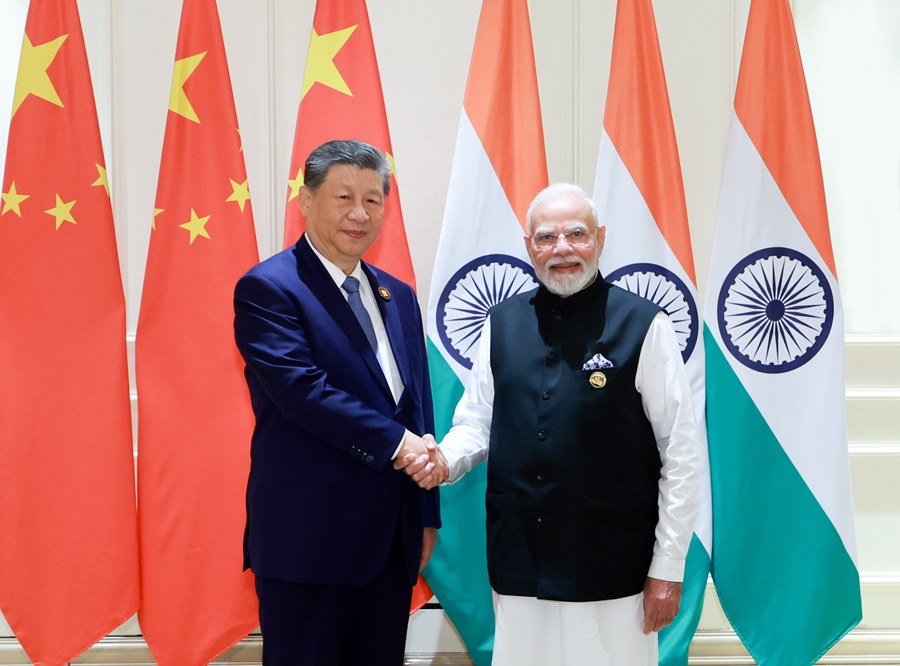
Xi’s presence was particularly consequential for the summit because China is due to take over the BRICS chairship in 2027.
The meeting suggested that India and China are seeking to stabilize their relationship even as major differences remain over the border, trade and their competing strategic relationships.
Modi and Putin deepen strategic ties
Modi met Putin on Sept. 11, one day before the leaders’ summit. The two leaders reviewed bilateral cooperation spanning politics, defense, energy, trade and other sectors, while also discussing the impact of the conflicts in Ukraine and West Asia on regional and global stability.
The meeting highlighted India’s continuing strategic relationship with Moscow despite pressure from Western governments over Russia’s war in Ukraine.
Putin also used the BRICS Business Forum to argue that the bloc should develop practical mechanisms for economic cooperation beyond Western-dominated structures.
“We are in favor of our interests,” Putin said in remarks reported by the Associated Press.
At the forum, Putin also criticized Western sanctions and argued that BRICS could serve as a platform for investment, technology, infrastructure and payment cooperation.
Putin and Xi share the BRICS spotlight
Putin and Xi were among the central figures at the summit, alongside Modi, but there is no confirmed public account of a separate bilateral Putin-Xi meeting during the New Delhi summit.
Their joint appearance was nevertheless politically significant.
Russia and China have increasingly used BRICS to promote a more multipolar international system and challenge what they describe as excessive Western influence over global institutions and economic rules.
Putin and Xi’s presence alongside Modi also underscored the increasingly prominent role of the India-China-Russia triangle within BRICS, even though the three countries have substantially different strategic interests.
The summit therefore provided a setting in which cooperation on global governance and economic issues could coexist with unresolved bilateral and geopolitical tensions.
Pezeshkian presses for alternatives to Western financial pressure
Iranian President Masoud Pezeshkian used the BRICS Business Forum to argue for greater economic independence among member states.
“BRICS must create an environment in which no country can disrupt the legitimate trade of another country through monopolizing a financial instrument or technology,” Pezeshkian said.
He also called for greater use of national currencies in trade between BRICS members.
“One of the most important steps is to expand the use of national currencies in trade among the members,” Pezeshkian said, according to Associated Press reporting.
Pezeshkian said pressure on Iran had entered a “dangerous phase,” arguing that economic sanctions had given way to military pressure.
“Food and energy security are two fundamental pillars of economic security,” he said.
The declaration itself stops short of endorsing a single BRICS currency. Instead, it supports continued work on cross-border payment interoperability and trade settlements using members’ local currencies while recognizing that there is “no one-size-fits-all approach.”
Energy security and maritime trade move to the forefront
The Middle East conflict has made energy security a strategic concern for BRICS members, many of which are major energy producers, consumers or both.
The declaration calls for energy market stability and “undisrupted flows of energy from diverse sources,” along with stronger protection of critical energy infrastructure and cross-border infrastructure.
BRICS also calls for resilient and diversified critical-mineral supply chains while emphasizing the sovereign rights of resource-rich states.
The focus reflects the widening connection between military conflict and economic security. Disruptions to shipping routes, energy infrastructure and supply chains can quickly affect countries far beyond the immediate theater of conflict.
AI and technology emerge as strategic priorities
The New Delhi Declaration also elevates artificial intelligence and emerging technologies within BRICS cooperation, linking technological development to economic growth, innovation and sustainable development.
Chinese President Xi Jinping proposed deeper cooperation among BRICS members on open-source AI, smart manufacturing and advanced technology training, including efforts to develop young technical talent across the bloc.
The declaration also backs implementation of the BRICS Leaders’ Statement on the Global Governance of Artificial Intelligence and references India’s AI Impact Summit in February 2026 and the World AI Conference and High-Level Meeting on Global AI Governance in Shanghai.
The technology agenda extends beyond AI. BRICS leaders also called for stronger cooperation on cybersecurity, digital technologies and efforts to combat cross-border cybercrime and scam networks.
BRICS warns of rising nuclear danger
The nuclear provisions extend beyond the immediate issue of attacks on safeguarded facilities.
BRICS leaders said they were concerned about “the growing risks of nuclear danger and conflict” and called for stronger disarmament, arms control and non-proliferation mechanisms.
The declaration also stresses the importance of existing nuclear-weapon-free zones and supports efforts to establish a Middle East zone free of nuclear weapons and other weapons of mass destruction.
The language reflects a broader concern that conventional military escalation in the Middle East could create risks for nuclear safety, proliferation and strategic stability.
Ukraine remains largely outside the declaration
The declaration does not explicitly name the Russia-Ukraine war.
Instead, it refers generally to ongoing conflicts, rising polarization and fragmentation, and increasing global military spending.
The omission is notable given Putin’s participation in the summit and the centrality of Russia to BRICS.
The bloc’s consensus-based approach allows members to cooperate on areas where their interests overlap while avoiding language that would force members into a common position on conflicts where their national policies diverge.
What New Delhi achieved
For India, the summit was as much about diplomacy as about the BRICS declaration itself.
Modi brought together Xi and Putin while maintaining engagement with Iran and the UAE and keeping the bloc focused on the economic consequences of the Middle East conflict.
The adoption of a unanimous declaration was itself significant after BRICS foreign ministers failed to issue a joint statement in May amid divisions over the Iran conflict.
The final document does not resolve the strategic differences inside BRICS. But it establishes common ground around several immediate concerns: preventing further escalation in the Middle East, protecting civilians and nuclear facilities, preserving energy and trade flows, and reducing the risks posed by a wider regional conflict.
The summit also demonstrated India’s effort to use BRICS as a diplomatic platform rather than an explicitly anti-Western alliance.
That balancing act is likely to remain central as China assumes the BRICS chairship in 2027 and the expanded grouping attempts to convert its growing economic and political weight into greater influence over global security and governance.