

China has approved eight new nuclear reactors across four projects, with total investment expected to exceed CNY170 billion ($25.2 billion), as Beijing accelerates nuclear power development to strengthen energy security, support rising electricity demand and advance its long-term climate goals.
The State Council approved the projects on July 31, covering two reactors each at the Jinqimen nuclear power plant in Zhejiang province, the Taipingling nuclear power plant in Guangdong, the Zhuanghe nuclear power plant in Liaoning and the Laiyang nuclear power plant in Shandong.
The approvals represent the first batch of nuclear projects approved for China’s 15th Five-Year Plan period, which runs from 2026 through 2030. They also extend a rapid nuclear construction program that has seen Beijing approve 10 or more reactors annually since 2022.
The projects will deploy China’s domestically developed third-generation nuclear technologies, including Hualong One, Hualong One Version 2.0 and Guohe One.
Four Projects, Eight Reactors
Phase II of the Jinqimen nuclear power plant in Zhejiang will comprise two Hualong One Version 2.0 reactors. The CNNC project will include private capital participation.
Once the Jinqimen site reaches its planned six-unit configuration, it is expected to support electricity supply in Zhejiang and the wider Yangtze River Delta while contributing to the region’s transition toward lower-carbon power generation.
In Guangdong, Phase III of the Taipingling nuclear power plant will add two Hualong One Version 2.0 reactors. CGN Power said each unit will have a capacity of 1,217 MWe. Once all six planned units at Taipingling are completed, the plant is expected to generate more than 55 TWh of electricity annually.
Phase I of the Zhuanghe nuclear power plant in Liaoning will comprise two standard Hualong One reactors, according to the project information supplied by China National Nuclear Corp. (CNNC).
In Shandong, the newly approved Laiyang nuclear power plant will use two 1,543 MWe Guohe One reactors, according to SPIC Industry-Finance Holdings Co.
The Laiyang project marks the start of large-scale, standardized construction of Guohe One reactors. The six-unit project is expected to have total investment of CNY128.3 billion and, once fully completed, is projected to become China’s largest nuclear power plant by installed capacity.
Hualong One Version 2.0 Expands
Six of the eight newly approved reactors will use Hualong One technology, reinforcing the design’s role in China’s nuclear expansion.
Hualong One is a third-generation pressurized water reactor developed by CNNC and China General Nuclear Power Corp. (CGN). Ten Hualong One units are in commercial operation domestically and internationally, while another 37 have been approved or are under construction, according to figures provided by China’s nuclear industry.
The latest approvals also expand deployment of Hualong One Version 2.0. Jinqimen Phase II and Taipingling Phase III have been designated as demonstration projects for the upgraded design.
The Version 2.0 reactors are intended to incorporate improvements derived from the experience of deploying Hualong One reactors at scale, supporting further standardization of China’s domestic reactor fleet.
CGN has said a single Hualong One unit can generate nearly 10 billion kWh of electricity annually, enough to meet the annual electricity demand of a medium-sized city with more than 1 million people.
Guohe One Moves Toward Larger-Scale Deployment
The Laiyang project will expand deployment of Guohe One, a third-generation nuclear technology developed by State Power Investment Corp. (SPIC) with China’s own intellectual property rights.
The first Guohe One reactor at the Rongcheng nuclear power project in Shandong has entered commercial operation, while the second unit is in the commissioning phase.
The approval of two Guohe One reactors at Laiyang marks a move toward larger-scale, standardized construction of the technology. Six units are ultimately planned for the Laiyang site.
The expansion gives China a second major domestically developed third-generation reactor technology alongside Hualong One as Beijing continues to build nuclear generating capacity.
Nuclear Power at the Center of the 2030 Energy Strategy
The latest approvals come as China advances an ambitious nuclear capacity target for the end of the decade.
“By 2030, installed nuclear power capacity will reach around 110 million kilowatts [110 gigawatts],” authorities pledged in the document, released by the National Development and Reform Commission on Monday.
The target is part of a broader energy strategy under which Beijing aims to increase the role of non-fossil energy sources in electricity generation while maintaining reliable power supplies.
China’s nuclear expansion is taking place alongside rapid growth in wind and solar power. Nuclear generation provides a stable source of electricity without the direct carbon emissions associated with fossil fuel generation, making it part of Beijing’s strategy to reduce the carbon intensity of the power system.
China has pledged to peak carbon emissions before 2030 and achieve carbon neutrality before 2060.
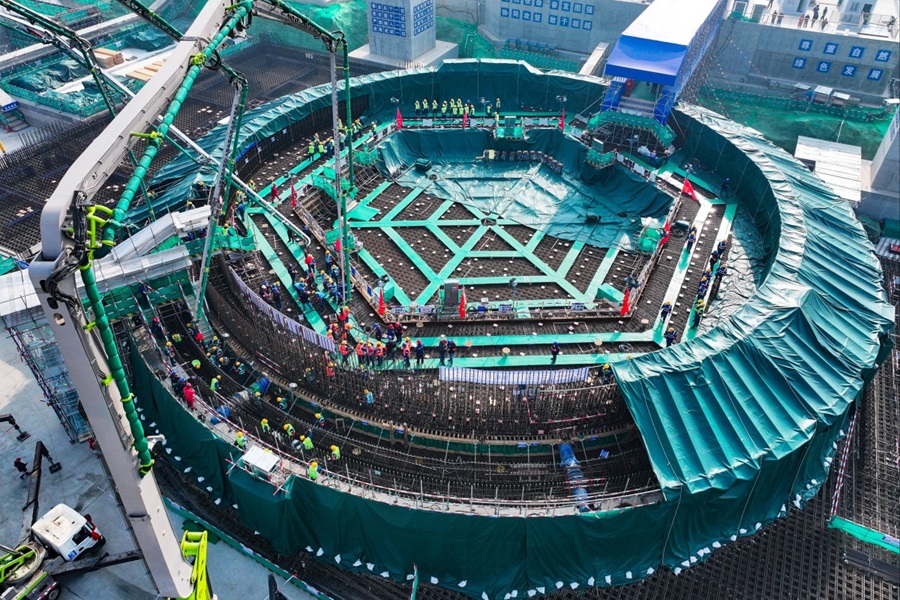
The country’s latest energy blueprint also calls for non-fossil energy sources to account for 50% of electricity generation by 2030. Hydropower, wind, solar and other renewable technologies will form the bulk of that expansion, with nuclear power providing additional low-carbon generation.
Rapid Growth Since 2022
China’s nuclear construction program has accelerated sharply in recent years.
The latest approvals bring the number of nuclear reactors approved by Beijing since 2022 to 49, with total investment approaching CNY1 trillion, according to the supplied industry data.
China’s nuclear generation reached approximately 467 billion kWh in 2025, according to the National Energy Administration.
The China Nuclear Energy Development Report 2026 said that by the end of 2025, China had 59 commercial nuclear power units with a combined installed capacity of 62.52 GW. An additional 35 units totaling 41.90 GW were under construction.
The figures demonstrate the scale of China’s nuclear construction pipeline. China has maintained the world’s largest under-construction nuclear capacity for 19 consecutive years, according to the supplied industry data.
Completed investment in nuclear power engineering reached CNY161 billion in 2025. Five nuclear projects approved that year included private capital participation.
Industry officials expect the country’s nuclear footprint to continue expanding beyond 2030.
Yang Changli, rotating chairman of the China Nuclear Energy Association, estimates that China’s installed nuclear power capacity could reach 200 million kW by 2040 as rising electricity demand creates additional room for nuclear generation.
Energy Security and Climate Goals
China’s nuclear buildout is taking place against a broader effort to strengthen energy security while reducing the carbon intensity of the electricity system.
Coal remains China’s largest source of electricity generation, although its share fell below 50% during the first half of 2026, according to the supplied data.
For Beijing, nuclear power offers a source of continuous, low-carbon electricity that can complement the country’s rapidly expanding renewable energy fleet.
The latest reactor approvals also have an industrial dimension. Nuclear projects sustain demand for domestic reactor designs, engineering services, specialized equipment and a large network of suppliers.
Li Jinkai, a distinguished professor at the School of Economics at the Beijing Institute of Technology, said the timing of the approvals was particularly important because they are part of the first batch of projects under the 15th Five-Year Plan.
“The 15th Five-Year Plan period represents the decisive sprint toward China’s goal of peaking carbon emissions before 2030,” Li said. He described nuclear power as an increasingly standardized component of China’s energy system.
“As a clean and stable baseload power source, the approval and construction of these new projects signal that China’s nuclear power construction has firmly entered a stage of large-scale, batched and normalized development,” Li said.
Li also said nuclear projects can promote investment growth, stabilize economic activity and attract private capital.
China’s Growing Role in Global Nuclear Power
China’s expanding nuclear fleet is also changing the global balance of nuclear generation.
The Statistical Review of World Energy reported that global nuclear generation reached a record 2,845 TWh in 2025, up 1.3% from 2024. The report said the increase was driven by China, which added more than 34 TWh of nuclear generation during the year.
The United States remained the world’s largest nuclear electricity producer in 2025, generating about 826 TWh. China ranked second at approximately 485 TWh, followed by France at about 390 TWh.
China’s nuclear generation has grown rapidly over the past decade, while its large construction pipeline is expected to continue narrowing the gap with the United States.
The country’s nuclear expansion is not limited to adding generating capacity. Beijing is simultaneously scaling its own reactor technologies, building domestic supply chains and developing standardized designs for repeated deployment.
The eight reactors approved on July 31 therefore represent another step in a broader Chinese strategy to expand nuclear power, strengthen energy security and increase the contribution of low-carbon generation to the country’s electricity system.