

A Swiss startup says the world’s first removable solar power plant installed between active railway tracks has successfully met its initial safety and performance targets, raising the prospect of turning thousands of kilometers of rail infrastructure into a new source of renewable energy.
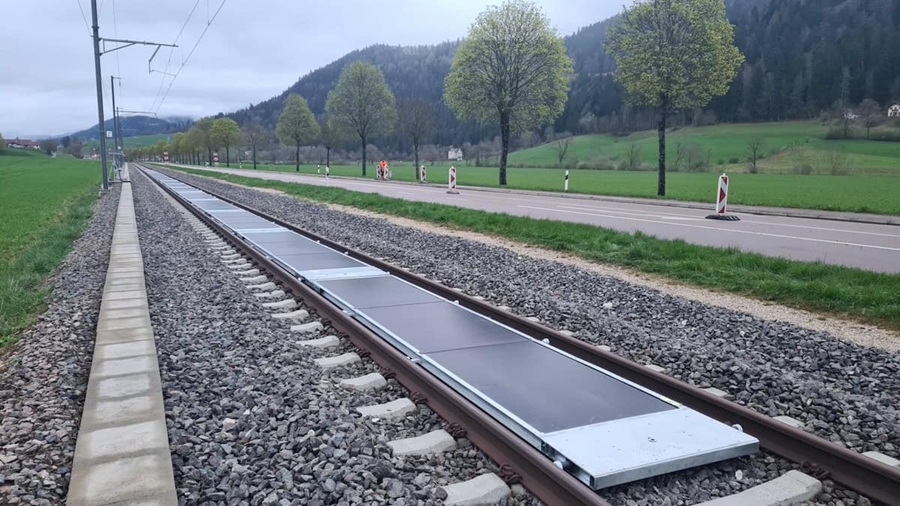
More than a year after solar panels were installed on a 100-meter stretch of railway in the village of Buttes in Switzerland’s canton of Neuchâtel, startup Sun-Ways says the pilot project has demonstrated that electricity can be generated safely between railway tracks without affecting train operations.
“We have achieved our goals – both in terms of railway safety and electricity production,” Joseph Scuderi, founder of Sun-Ways, told Swissinfo.
According to the company, more than 11,000 trains have passed over the installation since it became operational in April 2025, with the system remaining “completely stable and safe.”
Turning unused railway space into a power source
The pilot project consists of 48 photovoltaic panels installed between railway rails on a line operated by regional transport company TransN. The solar installation has a capacity of about 18 kilowatts and is designed to generate roughly 16,000 kilowatt-hours (kWh) of electricity annually.
Electricity produced by the panels is fed into the local power grid. Despite a month-long interruption caused by snow and scheduled maintenance work, the installation generated more than 16,000 kWh of electricity between May 20, 2025 and the first year of operation — enough to meet the average annual electricity needs of three to four households.
Unlike conventional solar farms, the Sun-Ways system is designed to be removable. The photovoltaic modules can be detached quickly when railway maintenance is required.
Scuderi said a six-meter section containing three solar panels can be disconnected and removed in about 10 minutes using specialized equipment.
“This aspect is fundamental when a sleeper needs to be replaced or welding work needs to be carried out on the rails,” he said.
No impact on train operations
One of the main concerns surrounding the project was whether solar panels installed between rails could interfere with railway operations, maintenance activities or train safety.
TransN said no such issues have emerged during the pilot phase.
“There were no conflicts with the infrastructure, maintenance or train services,” Aline Odot, spokeswoman for TransN, told Swissinfo.
The company also reported receiving no complaints from train drivers regarding glare from the solar panels, another issue frequently cited by critics of the concept.
Sun-Ways originally explored using brushes attached to trains to clean dust from the solar panels. However, the company found that trains themselves effectively solved the problem.
“However, we have found that every time a train passes, an air movement is created that blows all the dust away,” Scuderi said.
Potential to expand across rail networks
Sun-Ways estimates that Switzerland’s rail network could eventually generate up to one billion kWh of solar electricity annually, excluding tunnels and routes with insufficient sunlight.
According to the company, that would be enough to supply around 300,000 households and account for approximately 2% of Switzerland’s electricity consumption.
The broader ambition extends far beyond Switzerland. “There are over a million kilometres of railway lines in the world,” Sun-Ways co-founder Baptiste Danichert said previously, according to Sustainability Magazine. “We believe that 50% of the world’s railways could be equipped with our system.”
The company argues that installing solar panels on existing railway infrastructure could help countries expand renewable energy generation without using farmland, forests or other undeveloped land.
International interest grows
The Swiss pilot has attracted growing attention from railway operators and energy companies abroad.
In February 2026, French national railway operator SNCF signed a technical cooperation agreement with Sun-Ways, giving the company access to data and operational feedback from the Swiss project.
“SNCF is an important partner because the potential in France is enormous, and this will give our work in Switzerland greater visibility,” Scuderi said.
France operates roughly 28,000 kilometers of railway lines and aims to meet 20% of its electricity needs through solar power by 2030.
Sun-Ways is also in discussions with Italian railway infrastructure manager RFI regarding a potential pilot project.
“The idea is to organize a pilot project by the end of the year,” Scuderi said.
Beyond Europe, partnerships have been established in South Korea and Indonesia.
A project known as the Korea Railway Solar Power Generation Project received government approval in September 2025 to install solar panels near Osong railway station during a two-year pilot phase. Indonesian solar energy company Mutitron Automa is also evaluating the technology.
“The technology needs further field tests to assess its feasibility,” Mutitron Automa Director Dieter Napitupulu told Swissinfo.
Challenges remain
Despite the positive early results, experts caution that scaling railway solar systems will require overcoming technical hurdles.
Julien Pouget, assistant professor at the University of Applied Sciences and Arts Western Switzerland (HES-SO), said one of the biggest challenges is transporting electricity efficiently over long distances.
“A specific electrical architecture is needed, because current technology is not suitable for sections longer than 500 meters,” he told the Swiss newspaper 24 Heures.
Researchers are exploring solutions to increase transmission voltage and improve the ability to move electricity generated along extended railway corridors.
For now, Sun-Ways is seeking to shorten the pilot period, which Swiss regulators originally set at three years. “We have proven that the solar power plant between the railway tracks is safe. The sooner we receive final approval, the sooner our partners abroad can also move forward,” Scuderi said.
If approved for wider deployment, the technology could transform railway networks into a new source of clean energy while making use of infrastructure that already spans cities, towns and rural landscapes.