

China’s solar exports reached an unprecedented level in March 2026, as countries across Asia and Africa accelerated their transition toward renewable energy in response to rising fossil fuel prices and geopolitical instability.
According to data analyzed by global energy think tank Ember, China exported solar components capable of generating 68 gigawatts (GW) of power during the month – more than double February’s total and 49% higher than the previous record set in August 2025. The figure is equivalent to the entire solar capacity of Spain.
Energy Crisis Drives Demand for Clean Alternatives
The surge comes amid a global energy crisis triggered by the ongoing US-Israel war with Iran, which has disrupted oil and gas supplies and driven up prices worldwide. Countries heavily reliant on fossil fuel imports, particularly in Asia and Africa, have turned to solar energy as a more stable and cost-effective alternative.
Asia and Africa together accounted for three-quarters of the increase in Chinese solar exports. Shipments to Asia doubled to 39 GW, while exports to Africa rose by 176% to reach 10 GW, both record highs.
Several countries posted particularly sharp increases. In Asia, India’s imports surged by 141%, while Malaysia and Lao PDR saw increases of 384% and 108%, respectively. In Africa, Nigeria, Kenya, and Ethiopia each imported more than 1 GW of solar technology in a single month for the first time.
Key Highlights
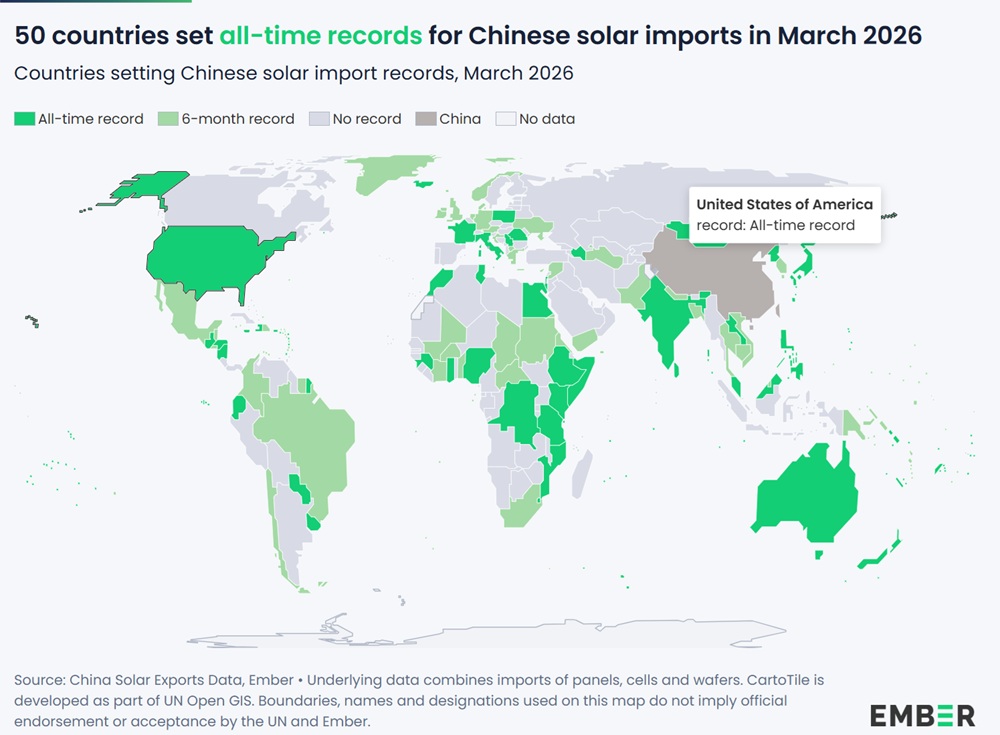
According to the Ember report, 50 countries set records for Chinese solar imports in March 2026, with a further 60 seeing the highest levels in six months. These include:
- Nigeria, Kenya, and Ethiopia each imported over 1 GW of solar PV technology in a single month for the first time, primarily in the form of solar cells
- 50 countries set all-time records for Chinese solar imports in March 2026, while 60 others recorded their highest levels in six months
- Exports to Asia doubled to 39 GW, marking a new record
- Shipments to Africa surged 176% to reach 10 GW, also an all-time high
- Asia and Africa together accounted for three-quarters of the total increase in Chinese solar export.
In Asia, the fastest-growing markets included:
- India: +141% (+6.6 GW)
- Malaysia: +384% (+1.8 GW)
- Lao PDR: +108% (+2.3 GW)
In Africa, rapid growth was recorded in:
- Nigeria: +519% (+1.2 GW)
- Kenya: +207% (+1.4 GW)
- Ethiopia: +391% (+1.1 GW)
Policy Changes and Price Pressures Fuel Export Boom
In addition to rising energy prices, policy changes in China played a significant role in driving the export spike. A planned adjustment to export tax rebates—effective April 1—added approximately 9% to solar panel costs, prompting manufacturers and buyers to accelerate shipments.
“The volumes exported are absolutely gigantic,” said Euan Graham. “We will see over the coming months how much of that was linked to the tax rebate and how much of that is additional demand – that might vary by region. But certainly a big part of this is the response to the energy crisis.”
Echoing this view, Qi Qin noted that policy timing likely played a decisive role in the sharp monthly increase. “Policy deadlines can create a sharp one-month jump in export, while by comparison, higher oil and gas prices caused by the war are… more likely to support demand over the medium term rather than explain such a strong spike in one single month,” she said.
Shift toward Local Manufacturing and Supply Chains
The data also highlights a structural shift in the global solar industry. Countries are not only importing solar technology but are increasingly developing domestic manufacturing and assembly capabilities.
China’s exports of solar cells and wafers, key components used in panel production, have been rising rapidly and surpassed panel exports in October 2025. In March, exports of cells and wafers reached 36 GW, compared to 32 GW for fully assembled panels.
This trend suggests that many countries are moving up the solar value chain, assembling panels locally to reduce costs and build industrial capacity.
Clean Technology Expands as Fossil Fuel Hedge
The rise in solar exports is part of a broader surge in clean energy technologies, including batteries and electric vehicles (EVs). Combined exports of these technologies increased by 70% year-on-year in March 2026, reflecting growing global demand for alternatives to fossil fuels.
Battery exports alone rose 44% from February to reach $10 billion, driven by the need to store solar energy for use during non-daylight hours.
According to Ember’s Global Electricity Review 2026, rapid growth in solar generation is already reshaping global energy markets. In 2025, solar power expansion displaced gas-fired electricity equivalent to all liquefied natural gas (LNG) shipments passing through the strategically critical Strait of Hormuz.
The report also found that the global EV fleet reduced oil demand by 1.8 million barrels per day last year—equivalent to 13% of U.S. crude oil production.
“Fossil shocks are boosting the solar surge. Solar has already become the engine of the global economy, and now the current fossil fuel price shocks are taking it up a gear. Countries are importing solar panels at record levels, and building up their own domestic assembly and manufacturing capabilities to address surging global demand,” according to Euan Graham, senior analyst at Ember.
Middle East Trade Disruptions limit regional uptake
Despite the global surge, the Middle East was the only region not to experience a significant increase in solar imports. Disruptions linked to the effective closure of the Strait of Hormuz have impacted trade flows, limiting the region’s ability to scale up imports despite high energy prices.
While March’s record-breaking figures underscore the growing importance of renewable energy, analysts caution that part of the surge may be temporary, driven by policy deadlines and front-loaded demand.
However, with fossil fuel markets remaining volatile and countries seeking greater energy security, the longer-term trajectory for solar and other clean technologies appears firmly upward.