

Turkiye has officially unveiled its first intercontinental ballistic missile (ICBM), marking a major milestone in the country’s rapidly expanding defense industry and underscoring Ankara’s ambition to strengthen its strategic deterrence capabilities.
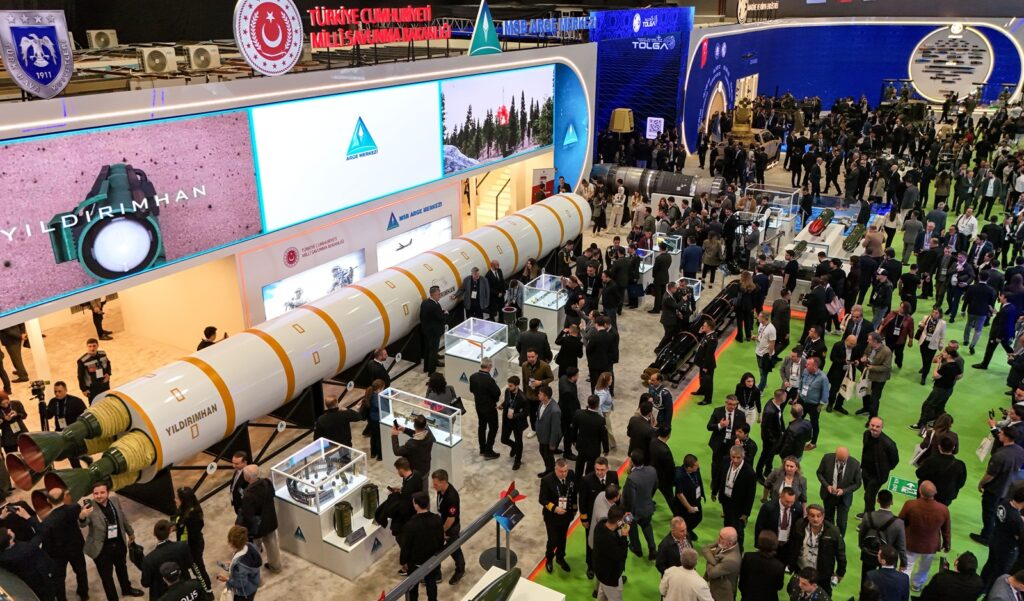
The missile, named Yildirimhan (Turkish for “lightning”) was showcased this week at the SAHA 2026 International Defense and Aerospace Exhibition in Istanbul. The full-scale model immediately drew international attention as one of the most significant Turkish defense announcements in recent years.
The program was introduced by Turkish Defense Minister Yasar Guler, who said the missile project had been under development for nearly a decade through the Ministry of National Defense’s research and development center.
The unveiling comes as Turkey continues to invest heavily in indigenous weapons systems, including drones, ballistic missiles, and advanced aerospace technologies, while positioning itself as a key defense actor in the Middle East and within NATO.
6,000-Kilometer Range Missile
According to information released during the exhibition, the Yildirimhan missile is designed to reach targets at distances of up to 6,000 kilometers, placing it within the internationally recognized range category of an intercontinental ballistic missile.
The missile reportedly has a maximum speed of Mach 25, carries a payload capacity of 3,000 kilograms, and is powered by four rocket engines. Turkish officials said the missile uses liquid-fuel propulsion technology.
🇹🇷 Türkiye'nin milli füzesi "YILDIRIMHAN" SAHA 2026'da tanıtıldı
— Anadolu Ajansı (@anadoluajansi) May 5, 2026
Milli Savunma Bakanlığı AR-GE Merkezince geliştirilen YILDIRIMHAN'ın özellikleri:
➔ Hipersonik füze olma özelliği taşıyor
➔ Mach 9 ile 25 arasında değişen hızlara ulaşabiliyor
➔ Yakıt olarak sıvı nitrojen… pic.twitter.com/w3z7FbLr4z
The Turkish Ministry of National Defense stated that the system is capable of carrying a three-ton warhead and is intended to be road-mobile. If launched from Turkish territory, the missile would theoretically be capable of reaching targets across Europe, Asia, and Africa.
The system remains in the prototype phase, and Turkish authorities confirmed that production has not yet begun. Officials added that laboratory testing has been completed, while preparations for field and ground testing are continuing according to schedule.
Yildirimhan Missile Specifications
- Hypersonic-capable intercontinental ballistic missile (ICBM)
- Reported speed range between Mach 9 and Mach 25
- Maximum range of approximately 6,000 kilometers
- Powered by four rocket engines
- Uses liquid nitrogen tetroxide-based liquid fuel propulsion
- Capable of carrying a 3,000-kilogram explosive payload
- Designed as a road-mobile missile system
- Developed by Turkey’s Ministry of National Defense R&D Center
Indigenous Propellant Technology
Turkish officials highlighted the development of domestic propellant technology as one of the project’s most significant achievements.
During a press conference at SAHA Expo 2026, Defense Minister Yasar Guler said: “We have elevated our work to a more advanced level through the technology base we established two years ago within our Ministry of National Defense R&D Center.”
He added: “Our Yıldırımhan Long-Range Missile represents a significant technological milestone as Turkey’s first liquid-fueled rocket missile system, capable of hypersonic-speed flight and possessing the country’s longest range.”
According to the ministry, the missile uses unsymmetrical dimethylhydrazine as fuel and dinitrogen tetroxide as the oxidizer.
Nilüfer Kuzulu, director-general of the Turkish Ministry of National Defence’s R&D Center, said the country had spent years building the required industrial capacity. “Developing this fuel is extremely difficult, and it was not something previously manufactured in Turkey,” she said.
“What began as small-scale laboratory work years ago has now been transformed into serial production. We now have both the production capability and the associated production facility.”
Kuzulu noted that Turkey had been working on hypersonic technologies and liquid-propellant systems for nearly a decade before integrating them into the Yildirimhan program.
Strategic Significance Beyond the Battlefield
Defense analysts say the significance of the Yildirimhan project lies not only in the missile itself but also in the technological capability required to develop such a system domestically.
Ozgur Unluhisarcikli, regional director at the German Marshall Fund of the United States, told Al Jazeera:
“In my view, Turkiye does not need ICBMs to deter any immediate security threat it is facing. Therefore, it is not the ICBM, but the capability to produce it that is significant for Turkiye.”
Analysts also pointed to the broader implications for Turkey’s civilian aerospace ambitions. Burak Yildirim, an Istanbul-based security and defense analyst, said the development of an ICBM platform could indirectly support Turkey’s Delta-V space launch program, which aims to place Turkish satellites into orbit using domestically produced rockets.
Ali Bakir, senior nonresident fellow at the Middle East Council on Global Affairs, described the unveiling as a major breakthrough for Ankara. “This development symbolises a leap in its missile capabilities and technological advancement, enabling Turkiye to join the exclusive ranks of a handful of countries possessing such advanced defensive technologies,” he told Al Jazeera.
Bakir added: “Furthermore, this milestone underscores Ankara’s commitment not only to enhance its military power and defensive capabilities but also to strengthen its deterrence, positioning itself as a key ultra-regional power.”
Regional Tensions Shape Defense Priorities
The unveiling of the Yildirimhan missile comes against the backdrop of escalating tensions across the Middle East.
The region has faced continued instability following the recent US-Israel conflict with Iran, maritime confrontations in the Gulf, and ongoing hostilities involving Gaza and Lebanon.
Earlier this year, Ankara reported that NATO air defenses intercepted ballistic missiles allegedly fired toward Turkish territory during heightened regional exchanges involving Iran. Tehran denied launching missiles at Turkey and suggested sabotage operations may have been involved.
Turkish leaders have increasingly emphasized the importance of strategic deterrence in response to regional security concerns.
President Recep Tayyip Erdogan previously called for Turkey to develop missile systems capable of ranges exceeding 2,000 kilometers. “As Turkey, we are located in a geography of high strategic importance, located in the heart of three continents, where global arm wrestling is never lacking … the first condition for survival in such a geography is deterrence,” Erdogan said at the time.
Challenges Ahead for the Program
Despite the technological breakthrough, experts note that the Yildirimhan system still faces significant operational and engineering challenges before entering active service.
Unlike modern solid-fuel ballistic missiles, the Yildirimhan is liquid-fueled, meaning it must be fueled before launch. Analysts say this could increase preparation time and leave the system more vulnerable to preemptive attacks.
The missile’s single-stage configuration and four-engine propulsion system are also considered unusual for an ICBM-class platform, potentially reflecting the technological hurdles Turkey continues to navigate as it enters the long-range missile arena.
For now, Turkish authorities have not announced a timeline for operational deployment. However, officials insist that work on production infrastructure, testing, and warhead development is continuing under the country’s broader “National Technology Initiative.”
The Turkish Ministry of National Defense stated: “As part of the National Technology Initiative, our Ministry will continue with determination to support the development of our defense industry, develop indigenous and national systems, and enhance Türkiye’s strategic deterrence capability.”