

Denmark and Greenland said Saturday that a proposed security agreement with the United States will not compromise Greenland’s sovereignty, seeking to clarify President Donald Trump’s claim that Washington would gain “permanent control” over the Arctic territory’s security.
The United States, Denmark and Greenland announced late Friday that they had reached an agreement allowing Washington to develop a significant military presence on Greenland while restricting US adversaries from establishing bases on the island.
The agreement is expected to be signed during the United Nations General Assembly next week. It would still require the necessary parliamentary procedures in Denmark and Greenland before taking effect.
The precise terms have not been released. Questions remain over the scale of any expanded US military presence and whether Washington would receive any formal authority over Greenland’s foreign policy or natural resources.
Trump said on Truth Social that the agreement would give the United States “permanent control over security, and all other needs, in Greenland.”
He also said the United States would “FOREVER have the complete ability to do what is necessary in Greenland in order to secure and defend the security of Greenland, and the United States of America”.
Danish and Greenlandic officials have described the proposed arrangement differently, emphasizing sovereignty, territorial integrity and Greenlanders’ right to self-determination.
Copenhagen and Nuuk emphasize sovereignty
Greenland Prime Minister Jens-Frederik Nielsen said the agreement recognizes Greenland’s constitutional position within the Kingdom of Denmark and the right of its people to determine their future.
“The agreement recognizes the sovereignty and territorial integrity of our kingdom and the right of the Greenlandic people to self-determination,” Nielsen said in a post.
In a separate statement, Nielsen said the agreement would strengthen security for Greenland, Denmark, the United States and the wider Western alliance.
“The agreement recognises Greenland’s interests and our place in international co-operation. It is for the benefit of us all,” he said.
Danish Prime Minister Mette Frederiksen also welcomed the prospect of an agreement, saying it would strengthen security while respecting Danish and Greenlandic interests.
“The deal ‘strengthens our common security in the Arctic and the North Atlantic area’ while also recognizing ‘the sovereignty and territorial integrity of the Kingdom and the right of the Greenlandic people to self-determination’,” she said in a joint statement with Nielsen.
Expected agreement on strengthened security in the Arctic and the North Atlantic Area pic.twitter.com/ARCMGgSA75
— Statsministeriet (@Statsmin) September 18, 2026
Danish Foreign Minister Lars Løkke Rasmussen said Saturday that the proposed agreement could mark a shift away from months of uncertainty. “Next week could be a good week – for Greenland, Denmark, and the United States,” Rasmussen said.
“A time of uncertainty will hopefully give way to a binding agreement that strengthens security in the Arctic and the North Atlantic, and thereby our shared security within Nato Europe – while respecting the Danish kingdom’s red lines,” he added.
Trump claims permanent US security authority
Trump’s description of the agreement has raised questions about what Washington and Copenhagen have actually agreed.
Trump said the arrangement would allow the United States to take whatever measures it considered necessary to defend Greenland and US security interests. He also said no US adversary would be allowed to maintain a military presence or make sensitive investments on the island without Washington’s written approval.
A US State Department official said the agreement would prohibit non-NATO military bases in Greenland, restrict sensitive investments by adversaries and prevent China and Russia from establishing bases on the territory. The official spoke on condition of anonymity because they were not authorized to comment publicly.
Denmark and Greenland have not publicly confirmed all of the details in Trump’s description.
That gap between the US president’s characterization and the statements from Copenhagen and Nuuk has left the scope of the agreement unclear.
Denmark and Greenland have repeatedly maintained that Greenland is not for sale. Trump’s demands for greater US control over the territory, including his refusal to rule out military action during earlier statements, triggered a diplomatic crisis between Washington and its NATO ally.
Strategic Arctic military presence
Greenland occupies a strategically important position between North America and Europe. Its location gives it importance for missile warning, space surveillance, Arctic operations and monitoring of emerging maritime routes.
The United States already maintains a military installation at Pituffik Space Base in northwestern Greenland. Formerly known as Thule Air Base, the facility was established under the 1951 Defense of Greenland Treaty and supports missile warning, missile defense and space surveillance missions for the United States and NATO.
The US military presence was considerably larger during the Cold War, when Greenland hosted multiple installations supporting American strategic forces and early-warning systems.
Marc Jacobsen, an associate professor at the Royal Danish Defense College and head of research at the Center for Arctic Security Studies, said an expanded US presence could include additional bases.
“I think it’s obvious that we can expect more bases in Greenland. But it’s important to say that if we look in the past, especially during the Cold War, the U.S. had immense military presence in Greenland,” Jacobsen said.
The agreement comes as Washington has placed greater emphasis on the Arctic because of its strategic geography, mineral resources and changing maritime environment.
NATO welcomes agreement after months of tension
Trump’s Greenland campaign had strained relations within NATO, particularly after European allies became more active in demonstrating their commitment to Arctic security.
In January, European NATO members sent military personnel to Greenland as a demonstration of military readiness. Eight European allies subsequently issued a joint statement reaffirming their commitment to Arctic security.
A NATO spokesperson said Saturday that the alliance welcomed the new agreement. The deal would “help advance security, stability and cooperation in this vital region”.
Adm. Giuseppe Cavo Dragone, chair of the NATO Military Committee, also described the agreement as “very, very welcome” during a visit to Copenhagen, without providing further details.
French President Emmanuel Macron said the agreement was significant because it preserved Danish sovereignty.
“I simply note that Danish sovereignty is respected, that international law is respected, and that this is what we were asking for. So it’s a good thing,” Macron was quoted as saying by AFP.
Questions remain over Greenland’s political future
Despite official statements welcoming the agreement, the proposed arrangement has prompted concern among some Greenlanders about the implications of a larger US role.
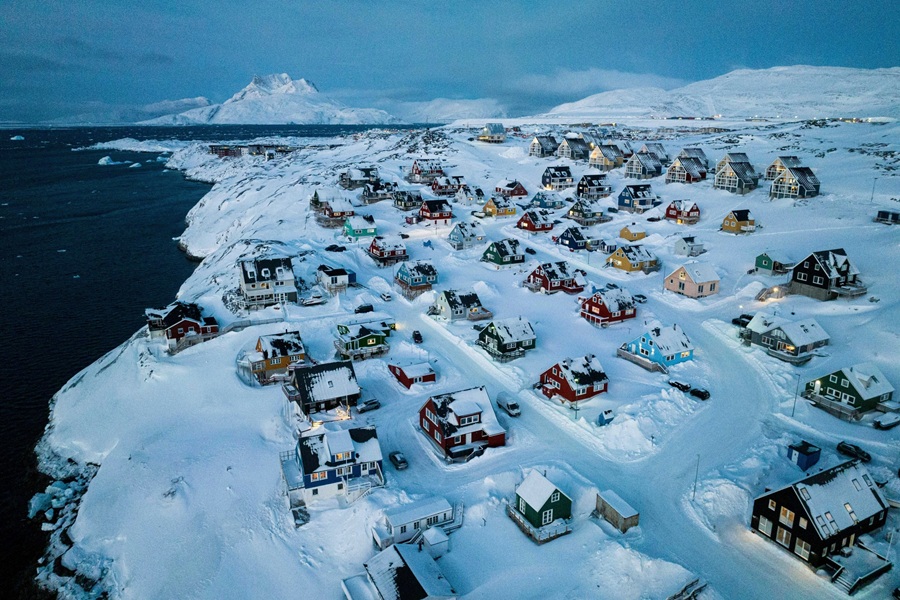
Greenland has a population of roughly 56,000 and extensive self-government within the Kingdom of Denmark. The territory has also pursued greater autonomy, with independence remaining an important issue in Greenlandic politics.
Some residents of Nuuk expressed opposition to any arrangement that could give Washington excessive influence.
“The US should not control Greenland. I think it’s better if we have cooperation with NATO,” said Jakob Ludvigsen, 65.
“Trump should stay far, far, far away from Greenland,” Marianne Hansen, a 71-year-old retired chef, told Reuters in Nuuk.
“He should not expect our children and grandchildren to become Americans in the future.”
Mikkel Vedby Rasmussen, a political science professor at the University of Copenhagen, said the agreement should not necessarily be viewed as the end of Washington’s interest in Greenland.
“This is probably not the end of President Trump’s ambitions for Greenland and certainly not the end of US strategic interest in the territory and its resources,” he said.
He added that any transfer of formal authority from Copenhagen to Washington could raise deeper questions in Greenland about the nature of external control.
“If Copenhagen cedes any formal power to Washington, which it has held for 1,000 years, it would raise questions for Greenlanders of whether ‘this is the beginning of replacing the colonial relationship with Denmark with a colonial relationship to the United States’,” he said.
Agreement still faces formal approval
The proposed deal represents the outcome of months of negotiations between the United States, Denmark and Greenland following Trump’s repeated demands for greater American control over the territory.
While the announcement has eased some of the immediate diplomatic tensions, the absence of a published agreement leaves key questions unanswered.
The parties are expected to formally sign the agreement during the UN General Assembly next week. Parliamentary procedures in Denmark and Greenland would then be required before it could enter into force.
Until the text is released, the balance between an expanded US military role and Denmark’s sovereignty over Greenland remains a central issue for the three parties and their NATO allies.