

China’s C919 narrow-body passenger jet completed its first scheduled international commercial flight to a foreign country on Aug. 12, marking a new stage in Beijing’s effort to establish a domestic commercial aviation industry with a foothold beyond the Chinese market.
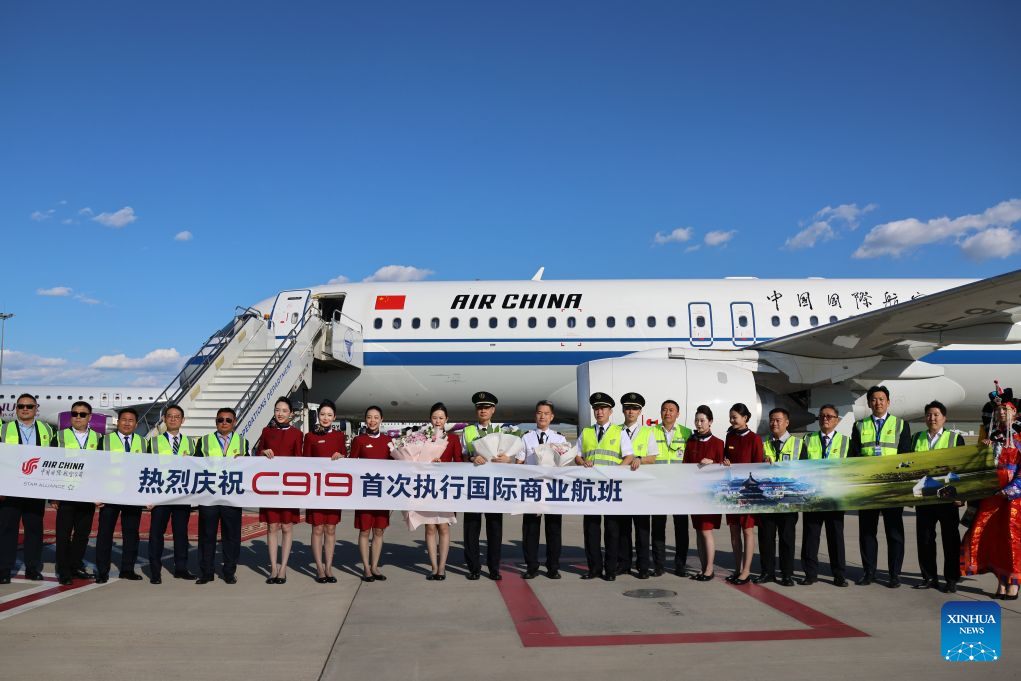
Air China operated the inaugural CA723 service from Beijing Capital International Airport to Ulaanbaatar, Mongolia, with the C919 departing at 3:17 p.m. Beijing time and landing at Chinggis Khaan International Airport at 4:58 p.m. local time, according to public flight data. The flight lasted 1 hour and 41 minutes.
The route, operated as a daily round trip under flight numbers CA723/CA724, is the C919’s first regularly scheduled international service to a foreign country. The aircraft had previously operated scheduled services to Hong Kong, its first destination outside mainland China.
The flight represents an important operational test for Commercial Aircraft Corp. of China Ltd. (COMAC), the state-owned manufacturer behind the C919, as it seeks to build experience with cross-border operations and eventually compete for a larger share of the global narrow-body aircraft market.
Milestone Beyond China’s Domestic Market
The C919 entered commercial service on May 28, 2023, when China Eastern Airlines operated its first commercial flight. Since then, the aircraft has expanded across China’s domestic network and has been adopted by the country’s three major state-owned carriers: China Eastern Airlines, Air China and China Southern Airlines.
According to COMAC figures cited in Chinese media, the C919 had served 57 routes linking 25 cities and carried more than 7.5 million passenger trips as of Aug. 10. The Beijing-Ulaanbaatar service raised those totals to 58 routes and 26 cities.
At Ulaanbaatar, the aircraft received a water-cannon salute, while Chinese diplomatic representatives and Mongolian transport and aviation officials attended a welcome ceremony. Passengers were also greeted by a cultural performance and attendants wearing traditional Mongolian clothing.
For Air China C919 captain Wang Yan, the flight carried particular significance. “This is indeed the first time for the C919 to fly an international route. As the captain operating it, I feel very proud. We have chosen the most skilled pilots in our fleet to carry out the maiden flight work and we have made careful preparations to make sure the flight will be operated successfully.”
Wang said the expansion from domestic operations to international services also carries a broader responsibility for the crews operating the aircraft.
“I believe from domestic routes, to regional and international routes, the expansion of China’s domestically-made aircraft came from the full effort of our civil aviation personnel. As a pilot, I also feel the great responsibility on my shoulders of flying our C919 well as part of routine work in the future.”
Mongolia Provides a Low-Risk International Test
The selection of Ulaanbaatar gives COMAC an opportunity to test the C919 in an international operating environment while remaining on a relatively short regional route.
The Beijing-Ulaanbaatar service also builds on established aviation links between China and Mongolia. Industry analysts cited in Chinese media have pointed to existing airworthiness arrangements and bilateral aviation cooperation as factors supporting the route.
The international operation goes beyond proving that the aircraft can fly between two countries. It provides an opportunity to develop procedures for overseas maintenance, aircraft support, spare-parts logistics, customs and international air-traffic coordination.
A China Daily report cited experts as saying overseas maintenance, aircraft support and route-support capabilities would be among the principal challenges for the C919’s international expansion. The first route is intended to help validate those processes before the aircraft moves into additional overseas markets.
Tian Linchuan, an assistant researcher at Shanghai Jiao Tong University’s School of Aeronautics and Astronautics, said the ability to operate scheduled cross-border services demonstrates the aircraft’s progress in safety, reliability and cost-effectiveness. He also argued that the Mongolia service could provide a model for future expansion into Southeast and Central Asia.
Boeing and Airbus remain the Benchmark
The C919 is designed for the same broad market segment as the Boeing 737 and Airbus A320 families. China has promoted the aircraft as a foundation for reducing its dependence on foreign commercial aircraft technology and developing a self-sufficient aviation industry.
But the international flight does not by itself establish the C919 as a global competitor to Boeing and Airbus.
The aircraft remains heavily dependent on international suppliers for critical systems and components, including its engines and avionics. The C919 also has yet to secure certification from major Western aviation regulators, a major obstacle to widespread sales and operations in markets where such approvals are required.
Scott Kennedy, a senior adviser at the Center for Strategic and International Studies, characterized the Mongolia service in blunt terms: “This is essentially a public relations move.”
Kennedy added: “Ulaanbaatar was likely chosen because of how close it is to Beijing. It doesn’t change the fact that the plane was years overdue, is composed of western components, and is less efficient than its Boeing and Airbus cousins.”
Kyle Chan, a fellow at the Brookings Institution focused on China’s industrial policy, emphasized the technical difficulty of developing a modern commercial jet.
“Large passenger aircraft and jet engines are extremely complex and challenging to manufacture. They require precision components, complex electro-mechanical control systems, and the ability to coordinate a vast global supply chain.”
Chan added: “There’s a reason there are basically only two major commercial aircraft makers in the world. Building large passenger jets that are safe and reliable is an order of magnitude more difficult than making EVs.”
The C919’s reliance on overseas technology has also given the aircraft strategic importance amid growing U.S.-China competition over advanced manufacturing and supply chains. China views the ability to develop large commercial aircraft as part of its broader drive for technological and industrial autonomy.
Passenger Experience Offers an Early Test
For passengers on the inaugural service, the aircraft’s performance was less about geopolitics than the experience inside the cabin.
Howard Deng, one of the passengers traveling to Ulaanbaatar, said he had not initially realized he was boarding a milestone flight. He later described his first C919 experience positively.
“The flight was very smooth,” said Deng. “It felt basically no different from a Boeing 737 or an Airbus A320.”
Deng said the cabin configuration, legroom and lavatory were comparable with other narrow-body aircraft he had flown.
Another passenger, Hu Yuan, told AFP that he felt: “a sense of pride” about flying an international route on a domestically produced aircraft.
He added: “I hope our domestic planes continue to improve in terms of comfort and overall passenger experience — even outperforming Boeing and Airbus.”
The comments illustrate one of the central challenges facing COMAC. Technical certification and production capacity are only part of the task. Airlines and passengers must also develop confidence in the aircraft’s reliability, maintenance ecosystem and long-term support.
Production Scale Is the Next Challenge
COMAC’s ability to increase production will be critical if the C919 is to move beyond its current position as a primarily Chinese-market aircraft.
The company has set an ambition to reach annual C919 production capacity of 200 aircraft by 2029. Industry reporting has described the target as part of a broader effort to accelerate industrialization and establish a larger supply base.
That ambition remains far below the scale at which Boeing and Airbus produce their competing narrow-body aircraft, but it would represent a major increase from COMAC’s current output.
The production challenge has strategic implications. A commercial aircraft program requires a reliable supply chain capable of producing not only airframes but also engines, avionics, control systems and thousands of other components at consistent quality and volume.
For China, that industrial ecosystem is almost as important as the aircraft itself.
International Expansion Will Be Gradual
The C919’s first international scheduled service therefore marks a beginning rather than a breakthrough into the global market.
COMAC has already used major international air shows to promote the aircraft, including appearances at the Singapore Airshow in 2024 and 2026 and the Dubai Airshow in 2025. The company has also sought to expand the presence of its smaller C909 regional jet in overseas markets.
The C919’s international future, however, will depend on more than the ability to operate a daily Beijing-Ulaanbaatar service. International certification, production reliability, supply-chain resilience, maintenance infrastructure and airline confidence will determine whether the aircraft can gain meaningful market share outside China.

For now, the Mongolia route provides COMAC with something it has lacked until recently: regular operational experience on a foreign commercial route.
The significance of the Aug. 12 flight lies less in its distance than in what comes next. If COMAC can use the service to establish reliable international support procedures and gradually accumulate operational experience, the C919 could have a foundation for expansion into other regional markets.
The broader ambition remains considerably more difficult: turning China’s first domestically developed mainline jetliner into a commercially competitive aircraft with a sustained international presence.