

The United States is preparing to pull its last aircraft carrier from the western Pacific, temporarily leaving the region without one of the most visible symbols of American military power as President Donald Trump continues the war against Iran and places greater emphasis on the Western Hemisphere.
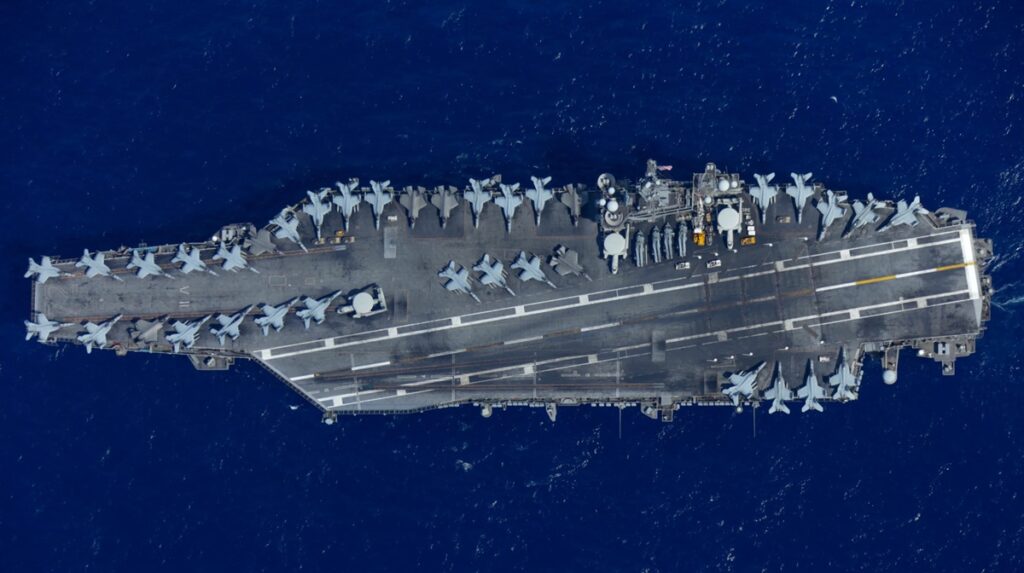
The USS George Washington is heading toward the Middle East to replace the USS Abraham Lincoln, which has been deployed for more than 260 days and whose mission has been extended well beyond its original schedule. The move will allow the Lincoln to return after an unusually prolonged deployment that has raised concerns among lawmakers, military families and former Navy personnel over conditions aboard the ship.
The temporary absence of an American carrier in the Pacific does not amount to a withdrawal from the region. But it exposes the growing pressure on a Navy attempting to sustain operations against Iran while maintaining commitments in the Indo-Pacific and supporting the administration’s increased focus on the Western Hemisphere.
Greg Poling, director of the Southeast Asia Program at the Center for Strategic and International Studies, said the administration has described the Pacific as a major priority behind the Western Hemisphere. Instead, he said, Washington is moving in the opposite direction.
“The administration says that the Pacific is supposed to be the most important behind the Western Hemisphere,” Poling said. The United States is “doing the exact opposite” of its previously expressed goal of pulling out of the Middle East.
Lincoln’s prolonged deployment exposes strain
The George Washington’s redeployment is primarily a response to the demands placed on the Lincoln, which has remained at sea for more than eight months while supporting U.S. military operations connected to the Iran war.
Reports about conditions aboard the Lincoln have included shortages of basic supplies, water contamination, plumbing problems, safety concerns, disruptions to mail and deteriorating mental health. Democratic lawmakers have called for greater scrutiny of the ship’s conditions, while the Pentagon has disputed aspects of the reporting.
The Navy’s acting secretary, Hung Cao, said the Lincoln’s crew had performed exceptionally under difficult circumstances and indicated that the carrier would return home soon. Defense Secretary Pete Hegseth has also rejected accounts portraying the situation as a broader crisis, saying conditions had been “misrepresented.”
President Donald Trump similarly dismissed concerns about the deployment on Aug. 14. Asked whether the deployment had lasted too long, Trump said, “No. No. No,” followed by, “Not nearly long enough.” He also rejected the suggestion that families were concerned about conditions aboard the carrier. “No, they’re not.”
Trump acknowledged that the Navy would soon replace the Lincoln with “another very similar ship,” referring to the George Washington’s planned deployment to the Middle East.
The president has repeatedly defended the war against Iran and minimized its costs, even as the conflict has lasted longer than initially expected and placed additional demands on U.S. forces.
Extended deployments create a readiness problem
The pressure on the Lincoln is part of a broader challenge facing the Navy’s carrier fleet.
The United States has 11 aircraft carriers, but their availability is constrained by the training, maintenance and overhaul cycles required to keep both ships and crews operational. Moving carriers between theaters can also disrupt deployment schedules and force other ships into extended missions.
Bryan Clark, a former Navy submariner and defense analyst at the Hudson Institute, said the current strain reflects a lack of preparation for a conflict that has continued longer than anticipated. “If we were going to mobilize to do this kind of conflict, and we anticipated it might go this long, we might have done some changes to the carrier schedule to make sure more would be available,” Clark said.
The Navy could potentially increase the number of deployed carriers in coming months. If the USS Theodore Roosevelt moves from San Diego toward the Middle East, the George Washington could eventually return to the Pacific.
But additional deployments would not eliminate the underlying problem. Ships returning from unusually long missions require maintenance, potentially creating a bottleneck at the Navy’s two carrier shipyards.
“We’ll end up with a maintenance debt that needs to be paid for the next few years,” Clark said. “We’ll probably have less carrier presence than we’ve had in the previous years because carriers will be lined up to get into the shipyard.”
Robert Farley, who teaches national security and diplomacy at the University of Kentucky and writes about aircraft carriers, said prolonged deployments also impose a direct human cost.
“People don’t get enough rest. It’s psychologically exhausting. And R&R is part of keeping the crew healthy,” Farley said. “Sometimes it’s framed as, ‘These people haven’t had a vacation.’ But we are dealing with well-known limits on the capacity of a crew to operate at top efficiency over time. And that just declines.”
The problem extends beyond a single deployment. If ships return from extended missions simultaneously, the Navy could face competing demands for maintenance, crew recovery and training, reducing the number of carriers available for new operations.
The carrier’s role is also under review
The operational strain comes as senior Navy officials are already reconsidering how heavily the service should depend on large aircraft carriers.
Michael Swaine, a senior research fellow in the Quincy Institute’s East Asia Program, has questioned whether carriers remain the most efficient means of projecting power in an increasingly contested maritime environment.
Large carriers can be threatened by long-range missiles and drones, particularly in a potential conflict with China. Smaller surface vessels, submarines and unmanned systems can provide other forms of strike, surveillance and maritime capability without requiring the same concentration of resources.
That debate is reflected in the Navy’s own strategic planning.
Chief of Naval Operations Adm. Daryl Caudle has called for a more flexible force built around smaller ships, unmanned systems and tailored groups of assets rather than routinely deploying carrier strike groups for every crisis. His February “Fighting Instructions” were designed to give commanders more options while reducing the strain associated with moving large formations around the world.
Caudle has argued that some missions currently assigned to carrier strike groups can be handled by smaller ships, helicopters, drones and other assets. The approach is intended to match military capabilities more closely to individual missions rather than treating the carrier strike group as the default response to every contingency.
That strategy could become increasingly relevant as the Navy attempts to balance competing demands across multiple theaters.
The immediate problem, however, remains the gap created by the George Washington’s departure from the Pacific.
China and the Indo-Pacific face a temporary carrier gap
The strategic consequence of that gap is clearest in the western Pacific, where China continues to expand military activity and challenge U.S. allies.
Beijing conducted naval exercises with Indonesia this month and has recently shown signs of increased military activity involving Japan and the Philippines, two key U.S. allies that have territorial disputes with China.
China also conducted military drills near Scarborough Shoal in the South China Sea, where Beijing and Manila have competing claims. Last month, a Chinese guided-missile destroyer conducted a live-fire exercise off Japan’s southernmost island of Okinotori.
The absence of an American carrier does not mean China is likely to invade Taiwan. The more immediate concern for Washington is the perception created by the carrier gap and what Beijing may be able to communicate to U.S. allies during the period of reduced American naval presence.
Clark said China could use the withdrawal as part of a broader effort to persuade regional governments that U.S. military power is becoming less reliable.
“They’re using this as part of the narrative to demonstrate to the Philippines, to Japan, to Indonesia and others that the U.S. is not the big dog in the western Pacific anymore,” Clark said. “They would just prefer that countries in the region decide that China is the bigger power and the U.S. is not able to guarantee their security anymore.”
Beijing sees the U.S. military presence in the region as a threat to China’s rise and an obstacle to its ambitions toward Taiwan, the self-governing island that China claims as its territory.
For Washington, maintaining a credible military presence in the Pacific is therefore about more than the number of aircraft carriers physically operating in the region. It is also about assuring allies that American forces can respond rapidly if a crisis develops.
Evan Sankey, a policy analyst at the Cato Institute who focuses on U.S. policy toward China, said aircraft carriers provide an important psychological component to that reassurance.
The absence of carriers, he said, “adds to the general sense that the U.S. is distracted by events in the Middle East.”
US seeks to reassure allies
U.S. officials have sought to make clear that the carrier redeployment does not represent a broader retreat from the Indo-Pacific.
Adm. Frank Bradley, head of U.S. Special Operations Command, was in Manila on Aug. 13, where he told Philippine counterparts that American special operations forces were prepared to expand joint exercises aimed at strengthening the alliance. He is also expected to travel to Japan.
“We have the ability to project force, the United States, anywhere on the globe,” Bradley told The Associated Press. “And when the threat in the region of the Middle East has been attended to, we will redeploy and reorient and be able to project that force wherever else it might be required.”
“I also feel very confident in the Armed Forces of the Philippines’ ability to protect their sovereignty here and for us to remain close with them,” he said.
Bradley’s comments highlight the distinction between a temporary carrier gap and a permanent change in U.S. strategy.
The Navy could restore a carrier presence in the Pacific within several months. But the timing will depend on the demands of the Iran war, the availability of other carriers and the maintenance requirements created by extended deployments.
That uncertainty is what concerns some U.S. allies.
A test of American force allocation
The movement of the George Washington ultimately illustrates a larger problem facing the U.S. military: American forces are finite, while the administration’s strategic priorities span multiple regions.
The Iran war has required sustained naval power in the Middle East. The administration has also emphasized the Western Hemisphere, while China remains the central long-term military challenge in the Indo-Pacific.
Aircraft carriers are among the most powerful tools available to the United States for projecting conventional military power, but there are only 11 of them. Their crews cannot operate indefinitely without rest, and the ships cannot remain deployed indefinitely without maintenance.
The Lincoln’s extended deployment therefore presents a dilemma that goes beyond one ship. Relieving the carrier is necessary to protect the crew and restore the vessel’s readiness. Sending the George Washington to the Middle East, however, temporarily reduces the visible U.S. naval presence in the western Pacific.
Trump has continued to defend the war against Iran and its strategic objectives.
Speaking in Garden City, New York, on Aug. 14, he said, “Pretty soon I’ll be declaring the Hormuz Strait a territory of the United States,” referring to the strategic waterway that has become central to the conflict and its effects on global energy markets.
He also defended the economic costs of the war and his stated goal of preventing Iran from obtaining a nuclear weapon.
“So remember that — when you have to pay a little bit more, you’re at $4, it’s OK,” he said. “I’ll never apologize. I did the right thing.”
For the Navy, however, the central question is not simply how much military power the United States can deploy at any given moment. It is how long that power can remain deployed without degrading the ships, crews and maintenance capacity needed for the next crisis.
The temporary absence of an American aircraft carrier from the western Pacific may therefore prove manageable if the Navy restores its presence within months. A more persistent pattern of carrier gaps, delayed maintenance and exhausted crews would carry much greater strategic consequences.
For China and U.S. allies across the Indo-Pacific, the issue will be whether Washington can demonstrate that the carrier withdrawal is a temporary consequence of the Iran war rather than evidence of a broader decline in America’s ability to sustain military power across competing theaters.