

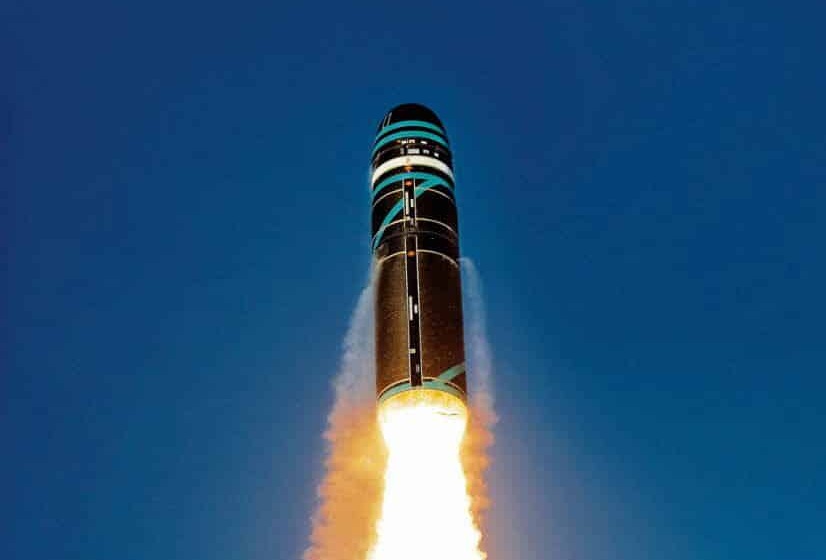
France on Oct. 6 conducted the first test launch of its upgraded M51.3 submarine-launched ballistic missile, marking a major step in the modernization of the country’s nuclear deterrent as Paris seeks to strengthen its strategic posture amid heightened tensions with Russia.
The missile was launched from the nuclear-powered ballistic-missile submarine Le Vigilant off Brittany and splashed down in the North Atlantic, several hundred kilometers from any coastline, according to France’s Ministry of the Armed Forces. The missile carried no nuclear warhead.
President Emmanuel Macron observed the launch from the French Navy vessel Auvergne and described the test as evidence of France’s strategic credibility.
“This is a very important moment for our strategic credibility,” Macron told troops onboard the French Navy vessel, according to the supplied reporting.
He also said: “Everything that has happened recently and what is happening today will be closely scrutinized by both our allies and our competitors alike, and it already is. Along the course we have set, this is a step forward.”
M51.3 Test Supports Submarine Deterrent
The M51.3 is the latest version of France’s M51 family of submarine-launched ballistic missiles. The Oct. 6 launch formed part of an acceptance test designed to certify Le Vigilant‘s ability to deploy the weapon following a major maintenance overhaul, the defense ministry said.
The ministry said the launch was conducted without a payload and “in strict compliance with international obligations.”
It also said the test “once again demonstrates the excellence of the high-tech solutions employed by French industry in the field of nuclear deterrence.”
The M51.3 is part of a broader modernization program for France’s nuclear forces. That effort includes the development of new ballistic-missile submarines and future upgrades to the Rafale fighter aircraft, including a planned hypersonic nuclear cruise missile capability.
The M51 missile is manufactured by ArianeGroup. France does not publicly disclose the official range of the M51.3. Public estimates put the range of the M51 family at roughly 9,000 kilometers or more, with the newer M51.3 variant estimated by the Bulletin of the Atomic Scientists to have a range exceeding 9,500 kilometers.
ArianeGroup has said the M51 can reach an altitude of more than 2,000 kilometers before reentering the atmosphere at speeds of up to Mach 20.
Macron Links Test to Nuclear Deterrence
Macron used the launch to underscore France’s commitment to maintaining an independent nuclear deterrent.
“To be free, one must be feared. And to be feared, one must be powerful,” Macron wrote on X. “This technical success further demonstrates the credibility of our nuclear deterrent, whose long-term viability is assured.”
In another message accompanying a video of the launch, Macron said: “Today we are stronger. The message has been sent loud and clear for wherever it must be received.”
The French president has increasingly emphasized the role of nuclear deterrence in European security. In March, he said France would expand its nuclear arsenal and proposed deeper cooperation with European partners, including joint exercises, possible short-term deployments of nuclear-capable assets on allied territory and closer consultations on deterrence.
Macron has described the concept as “forward deterrence,” although the precise arrangements for extending the reach of French nuclear protection to European partners remain undefined.
“Our nuclear deterrent protects us and will continue to protect us,” Macron has argued.
Test Comes Amid Tensions With Russia
The M51.3 test comes against a backdrop of heightened tensions between Russia and Western countries over the war in Ukraine and broader European security.
Macron has warned of changes in the nature of “Russian aggression and threats” against European countries following a series of attacks described by Western governments as “hybrid” operations. In mid-September, he said such actions would “not go unanswered.”
The French test announcement did not directly mention Russia. It followed warnings from Russian President Vladimir Putin concerning Western actions involving Kaliningrad, the Russian exclave between NATO members Poland and Lithuania.
Moscow has repeatedly warned that it would defend Kaliningrad, including with nuclear weapons if necessary. NATO, meanwhile, has said none of its “exercises or activities pose a threat to the territory of the Russian Federation.”
Putin has also said Russia has no plans to attack European countries and wants peaceful coexistence.
The competing messages highlight the increasingly prominent role of strategic deterrence in European security calculations as governments reassess their defense postures.
France Maintains Independent Nuclear Force
France maintains a nuclear force based on submarine- and air-launched weapons. Four ballistic-missile submarines form the backbone of its sea-based deterrent.
The country has approximately 290 nuclear weapons and spends roughly €5.6 billion annually maintaining its nuclear arsenal, according to the supplied reporting. That makes France the world’s fourth-largest nuclear weapons state by stockpile, behind Russia, the United States and China.
Britain maintains an estimated 225 nuclear warheads, while Russia and the United States each possess more than 5,000, according to the figures provided.
France’s nuclear deterrent remains under national control, reflecting Paris’ long-standing policy of maintaining an independent strategic capability rather than relying exclusively on the US nuclear umbrella.
The M51.3 upgrade is therefore significant beyond the successful firing itself. It forms part of a long-term effort to ensure that France’s sea-based nuclear force remains operationally credible as its submarine fleet, missiles and associated delivery systems undergo modernization.
For Macron, the Oct. 6 launch also served a broader strategic purpose: demonstrating to both European partners and potential adversaries that France intends to preserve and modernize the capabilities underpinning its nuclear deterrent.