

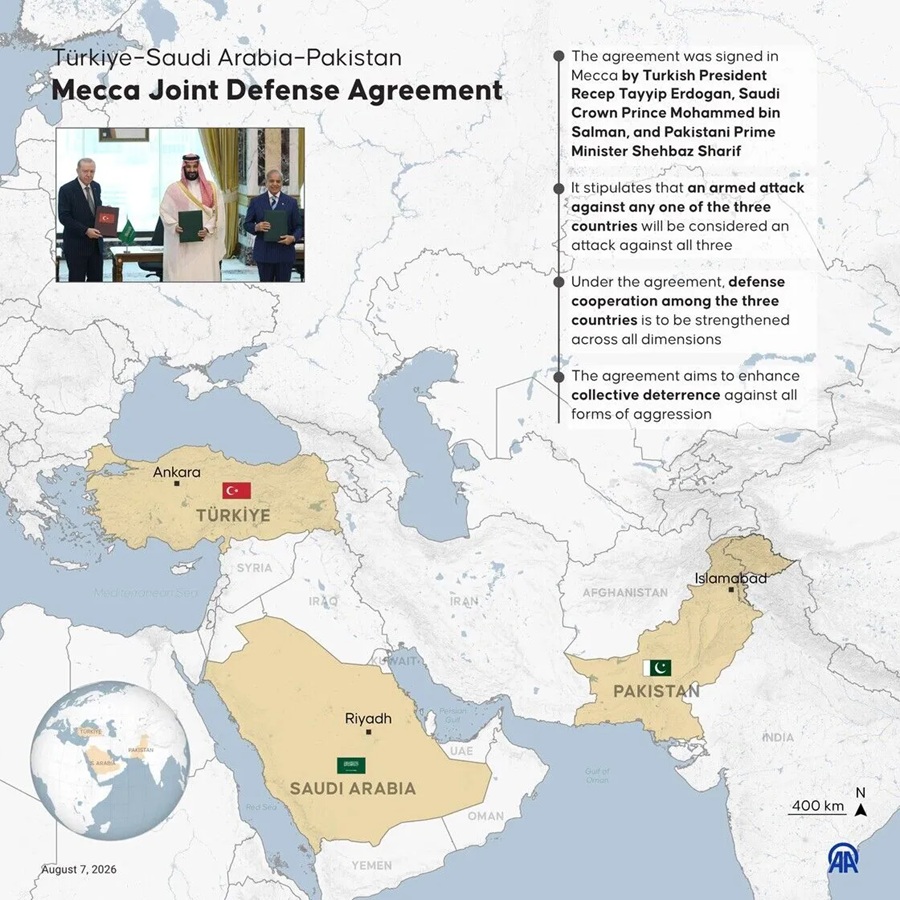
Saudi Arabia, Turkey and Pakistan signed a trilateral defense agreement in Mecca on Aug. 7 that commits the three countries to regard an armed attack against any one of them as an attack against all three, establishing a new framework for collective deterrence as regional security tensions remain high.
The Mecca Joint Defense Agreement was signed by Saudi Crown Prince and Prime Minister Mohammed bin Salman, Turkish President Recep Tayyip Erdogan and Pakistani Prime Minister Shehbaz Sharif during a summit at Al-Safa Palace in Mecca.
The agreement brings together three major Muslim-majority powers with different but potentially complementary strategic capabilities. Saudi Arabia is a major energy producer and regional power, Pakistan is a nuclear-armed state with extensive military experience, and Turkey is a NATO member with one of the alliance’s largest armed forces and a major defense industry.
The pact was concluded against the backdrop of the wider regional conflict involving Iran. Saudi Arabia and other Gulf states have faced missile, drone and maritime threats, while the Strait of Hormuz and Red Sea have remained central to regional security and global energy flows.
Egypt and Jordan are expected to join the alliance at a later stage.
Collective Defense at the Center of the Pact
The agreement’s central provision is a mutual-defense commitment. “The agreement is intended to strengthen collective deterrence against any act of aggression, and stipulates that any armed attack against any one of the three states shall be regarded as an attack against them all,” the three governments said in their joint statement.
“It further provides for the enhancement of all aspects of defense cooperation among the three States,” the statement added.
Why have Saudi Arabia, Pakistan and Turkey pledged mutual defense? Reuters explains the regional realignment behind a new pact signed in Mecca by three major Sunni Muslim US allies https://t.co/aSv2M0OJYW pic.twitter.com/34h8IXLQlg
— Reuters (@Reuters) August 7, 2026
The agreement also provides for expanded defense cooperation among the three countries, with Turkish officials saying areas of cooperation include defense-industry collaboration and military interoperability.
The language establishes a political commitment to collective defense, but the agreement does not publicly spell out an automatic military response or specify the forces that would have to be deployed following an attack.
Turkish Foreign Minister Hakan Fidan said on Aug. 8 that the pact was technically comparable to NATO’s Article 5, but he also said the three countries would determine through consultations the “degree, form, and format” of assistance required if one member were attacked.
The practical strength of the arrangement will therefore depend on how the three governments translate the political commitment into operational procedures, military planning and deterrence.
Turkey Says Agreement is Not Directed at Iran
Ankara has repeatedly emphasized that the agreement is defensive and is not intended to establish an anti-Iran military coalition.
Fidan said the new pact was not directed against Iran or any other country. Turkish officials have described the arrangement as “purely defensive in nature” and “not against any specific actor.”
The officials said the agreement complements existing alliances rather than replacing them. Turkey’s NATO membership and its regional security partnerships, they said, are “complementary rather than alternative” frameworks.
The agreement is also described as open to participation by additional regional countries.
Erdogan said the pact was based on collective deterrence and would deepen defense cooperation, support joint defense-industry projects and strengthen efforts to combat terrorism.
“The agreement, which also reaffirms the right of defense as defined in Article 51 of the UN Charter, targets no country and is open to the participation of all brotherly countries that aim for the peace, prosperity, and stability of our region,” Erdogan said on X.
Saudi Arabia likewise sought to distinguish the agreement from the creation of a new military bloc.
“The agreement does not represent any orientation toward building a military axis or sectarian/religious bloc, and it is not linked to nuclear endeavors or an arms race, but rather to building sustainable self-reliant capabilities,” the Saudi statement read.
“The agreement does not come at the expense of the Kingdom’s strategic and strong relations at the Gulf, Arab, and international levels.”
Pakistan’s Deputy Prime Minister and Foreign Minister Ishaq Dar also described the agreement as defensive and said it was not directed against any particular country. Pakistan said the framework does not replace existing agreements and remains open to other countries that share its principles.
Saudi Arabia Seeks Greater Regional Deterrence
For Riyadh, the agreement adds another layer to its defense partnerships at a time when threats to the kingdom have expanded across multiple fronts.
Saudi Arabia has faced attacks and threats from Iran-aligned forces, including missile and drone attacks linked to the wider regional conflict. Before the Mecca summit, a Saudi official said Riyadh expected possible attacks against energy facilities, ports and airports from Iranian-backed groups in Iraq and Yemen.
The kingdom has also faced repeated threats to energy infrastructure and maritime traffic along the Red Sea.
Those risks give the new defense agreement immediate relevance. The pact offers Riyadh a formal framework for consultation and defense cooperation with two states that possess substantial military capabilities.
But its deterrent value will depend on whether potential adversaries believe an attack on Saudi Arabia could trigger meaningful assistance from Turkey and Pakistan.
Houthi Strike Puts Pact’s Deterrence Under Scrutiny
That question became more immediate on Aug. 9, two days after the agreement was signed.
Yemen’s Iran-aligned Houthi movement attacked a Saudi Aramco refinery in Jazan with a drone, according to Reuters. Saudi authorities said the resulting fire was extinguished and there were no casualties. The Houthis claimed responsibility, citing what they described as a Saudi embargo, a justification Riyadh rejects.
The attack does not automatically trigger a military response under the Mecca agreement. The pact establishes that an armed attack against one member is regarded as an attack against all, while Fidan has said the three governments would consult on the form and degree of assistance.
That makes the Jazan strike an early test of the security environment in which the new framework will operate, although it remains unclear whether the governments will formally invoke the pact or how they would characterize the attack under its provisions.
The incident also illustrates the challenge facing the agreement. Deterrence depends not only on the existence of a mutual-defense commitment but also on the credibility of the response that could follow an attack.
Pakistan Builds on Its Saudi Defense Relationship
The Mecca agreement expands on a defense relationship between Saudi Arabia and Pakistan that was formalized last year.
On Sept. 17, 2025, Saudi Crown Prince Mohammed bin Salman and Prime Minister Shehbaz Sharif signed the Strategic Mutual Defense Agreement in Riyadh. Pakistan’s Foreign Ministry said the agreement was intended to strengthen defense cooperation and joint deterrence and stipulated that aggression against either country would be considered aggression against both.
The new trilateral pact adds Turkey to that existing Saudi-Pakistani framework.
Pakistan brings substantial military experience to the arrangement, while its long-standing defense relationship with Saudi Arabia provides an established foundation for bilateral cooperation.
Prime Minister Shehbaz Sharif described the new agreement as a “historic pact” that would serve as a “shield of peace” for the three countries and the wider Muslim community.
In a post on X, Sharif also praised Pakistan’s army chief, Field Marshal Asim Munir, saying his “untiring efforts and utmost dedication” had contributed significantly to the agreement.
Defense analyst Abdullah Khan described the trilateral agreement as a natural evolution and formalization of decades of strategic ties among Pakistan, Saudi Arabia and Turkey. He said the changing regional security environment and evolving nature of warfare had increased the need for closer cooperation.
Khan said the pact was “purely defensive” and that collective deterrence was intended to increase the cost of aggression and prevent conflict.
He identified different strengths among the three countries, including Pakistan’s military experience and escalation-management expertise, Saudi Arabia’s economic power and regional influence, and Turkey’s defense technology and industrial capabilities.
Turkey Sees Opportunity for Defense Industry
For Turkey, the agreement creates additional opportunities for defense-industrial cooperation and closer military coordination with two important regional partners.
Turkish officials said the pact would expand defense cooperation, including joint defense-industry projects and military interoperability.
Fidan said negotiations had taken two years and eight months. He said the three countries would establish a committee of ministers similar to a mechanism within NATO and create a general secretariat in Saudi Arabia, while operational details would be worked out at the first committee meeting.
Ankara also wants the framework to expand beyond the three founding members. “Our president’s vision is that we don’t remain limited to three countries, that we grow and bring together all (regional) countries under this roof,” Fidan said. He said Egypt could potentially join the arrangement once certain technical issues are resolved.
The possibility of expansion would give the arrangement a broader regional dimension, although no additional country has been formally admitted under the agreement.
Iran Criticizes the Agreement
The pact has drawn criticism in Iran, where officials have questioned whether the arrangement will improve Saudi Arabia’s security.
Ebrahim Rezaei, a member of Iran’s Parliament’s National Security and Foreign Policy Commission, criticized the agreement on X.
“The Saudis should know that a paper agreement with Turkey and Pakistan will not bring them security, just as years of one-sided ‘milking’ by the Americans did not bring them security. Change your policies so that you do not have to #BegForSecurity from others,” he wrote.
Iranian analyst and former politician Abdolreza Davari also downplayed the potential risks posed by the pact to Tehran.
“What difference does it make? Will it be more difficult than the pressure the U.S. and Israel have created on Iran? Is the power of the U.S. and Israel greater or these three countries?” he said in a phone call from Tehran.
The Iranian criticism contrasts with the position of the three signatories, which have repeatedly stressed that the agreement does not identify Iran or another state as an adversary.
At the same time, the pact’s emergence during a period of heightened confrontation involving Iran gives it broader strategic significance.
How the New Defense Framework Will Work
The three countries have agreed to establish mechanisms to put their new defense relationship into practice, but many operational details have yet to be finalized.
Fidan said the countries plan to create a committee of ministers and establish a general secretariat in Saudi Arabia. He said the details of how the new framework will operate will be discussed at the committee’s first meeting.
The agreement also calls for broader defense cooperation, including work between the three countries’ defense industries and greater military interoperability. That could involve closer coordination between their armed forces and expanded cooperation on defense technology and production.
The agreement does not replace Turkey’s membership in NATO or the three countries’ existing bilateral and multilateral defense arrangements. Turkish officials have said the new framework is intended to complement those relationships rather than compete with them.
Fidan has compared the agreement technically with NATO’s Article 5, which treats an attack on one member as an attack on all. But the Mecca agreement does not publicly set out an automatic military response. Fidan said the three countries would consult on the “degree, form, and format” of assistance if one of them were attacked.
That leaves an important question for the new framework: how the three governments would translate their collective-defense commitment into military action during an actual crisis. The answer is expected to emerge as the countries establish their joint institutions and procedures.
A New Layer of Regional Security Cooperation
The Mecca Joint Defense Agreement reflects a broader effort by regional powers to strengthen their own security relationships as the Middle East faces a more fragmented and unpredictable threat environment.
For Saudi Arabia, the pact provides another channel for defense cooperation with two militarily capable partners at a time when the kingdom is confronting missile, drone and maritime threats.
For Pakistan, it extends an established defense relationship with Saudi Arabia into a trilateral framework while deepening its strategic relationship with Turkey.
For Turkey, it offers a new mechanism for regional defense cooperation, defense-industry partnerships and military interoperability while remaining compatible, according to Ankara, with its NATO commitments.
The agreement also carries significance beyond the three signatories because of its potential to expand. Fidan has said Erdogan wants the framework to include additional regional states, with Egypt identified as one possible candidate.
Its immediate test, however, is likely to be implementation.
The Houthi attack on the Jazan refinery on Aug. 9 came only two days after the pact was signed and highlighted the type of security challenge the agreement is intended to deter. It remains unclear how Turkey and Pakistan would respond if Riyadh formally sought assistance following such an attack.
The Mecca agreement represents a substantial political commitment, but its ultimate strategic weight will depend on what happens after the signing: how quickly the three countries establish their joint mechanisms, how closely their militaries cooperate, whether the framework expands and, most importantly, whether potential adversaries believe the collective-defense pledge will translate into meaningful action.
For now, Saudi Arabia, Turkey and Pakistan have established a common principle: an armed attack against one will be regarded as an attack against all three. The next stage will determine what that principle means in operational terms.