

The leaders of the Scottish National Party, Plaid Cymru and Sinn Féin have signed a joint memorandum calling for constitutional change across Scotland, Wales and Northern Ireland, asserting their nations’ right to determine their own futures and saying those futures belong in the European Union.
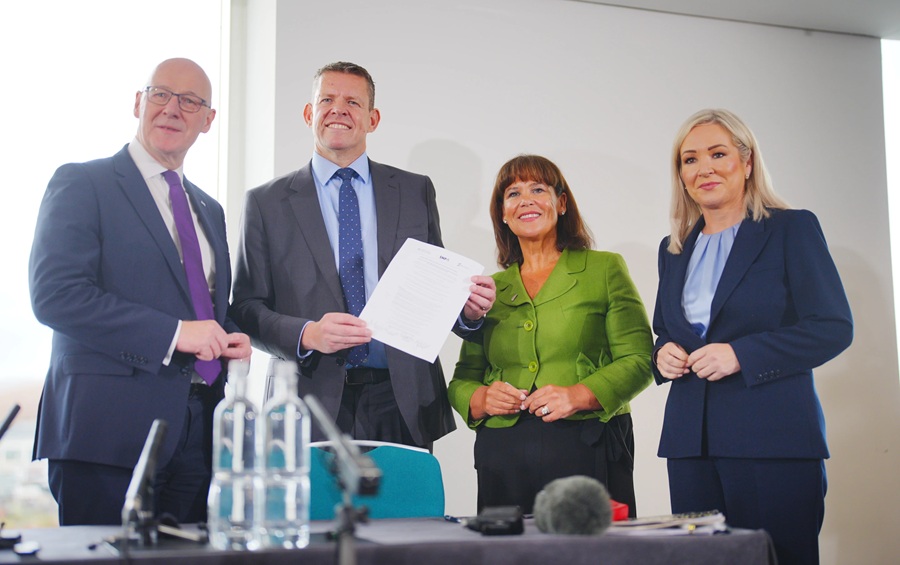
Scottish First Minister John Swinney, Welsh First Minister Rhun ap Iorwerth and Northern Ireland First Minister Michelle O’Neill signed the memorandum in Cardiff on Sept. 14 alongside Sinn Féin President Mary Lou McDonald.
The four leaders met in their capacity as party leaders rather than as representatives of their respective governments. The agreement is therefore a political statement by the three parties rather than a binding constitutional settlement. Contemporary reporting confirms that the document calls on the British Government to “prepare for, plan and facilitate constitutional change.”
The memorandum opens by emphasizing the distinct identities and political traditions of Scotland, Wales and Ireland and states that each has the right to determine its future through democratic means.
“Each of our nations has the right to determine its own future, through democratic means and in accordance with the wishes of its people.”
It says the parties are joining forces to work “constructively with one another in the shared interests of our people” and argues that the nations and communities they represent deserve “greater ambition, greater economic opportunity and a stronger voice in determining their own futures.”
Parties say Westminster’s role is coming to an end
The strongest political language in the agreement is directed at Westminster.
“The political landscape across these islands is changing.” The memorandum continues: “For the first time ever, there are First Ministers in Scotland, in Wales and in the North of Ireland who are all committed to independence from the United Kingdom.”
It then declares: “For people watching across these islands – for people watching around the world – there could be no clearer sign that Westminster’s time is coming to an end.”
The leaders say they believe in a model based on cooperation among nations as equals. “We believe there is a better way: nations working together as equals, sharing ideas and expertise, and building relationships based on mutual respect and common interests.”
They add: “Momentum is behind our movements; we believe that constitutional change is coming.”
The agreement commits the three parties to strengthening cooperation and identifying practical areas where they can work together.
Economic cooperation and energy
The memorandum goes beyond constitutional issues, setting out areas for cooperation on economic policy, energy and international relations.
On the economy, the parties say they want to share ideas and experience on building “productive, prosperous economies that create good jobs, tackle inequality and ensure that wealth and opportunity are spread more fairly.”
The agreement states: “We reject Whitehall’s broken economic model and will instead build economies which deliver social justice and reduce inequality across our nations.”
The parties also call for greater use of their domestic energy resources, particularly renewable energy. “Expanding our own energy resources, particularly our vast resources of renewable energy, to bring down bills for families and businesses. The energy wealth of our nations should serve the needs of our people.”
The language places economic sovereignty and energy policy alongside the parties’ broader constitutional ambitions.
Brexit and the European Union
The memorandum explicitly links the parties’ constitutional ambitions with their opposition to the UK’s departure from the European Union.
Under a section covering Europe and international cooperation, the agreement states: “Brexit has damaged our economies and limited opportunities for our people. We believe the future of our nations belongs in the European Union.”
The parties say they want to rebuild and strengthen relationships with the European Union, with a particular focus on trade, investment, culture and cooperation.
“We want to work together to rebuild and strengthen those European relationships, creating greater opportunities for trade, investment, culture and cooperation.”
The statement therefore frames closer European integration as part of the parties’ proposed future political and economic model.
Self-determination at the center of the agreement
The memorandum’s constitutional section sets out the principle that the parties say unites them despite differences in their individual positions.
“Our nations have the right to self-determination: No Westminster government has the right to block democracy or undermine the principle that our people will decide their own future.”
The agreement immediately qualifies that shared position by recognizing that the three parties have different constitutional arrangements and political circumstances.
“We recognise that our parties have different constitutional positions and that each nation will determine its own future in its own way and in its own time.”
That distinction is central to the agreement. While the three parties share a commitment to self-determination, the memorandum does not establish a common timetable for independence or Irish reunification.
The parties say their shared objective is to ensure that their nations’ voices are heard and that cooperation between Scotland, Wales and Ireland is strengthened.
They conclude the constitutional section with a direct appeal to the UK government: “We call for the British Government to prepare for, plan and facilitate constitutional change in each jurisdiction.”
Scotland, Wales and Northern Ireland face different constitutional paths
The political circumstances of the three nations are not identical.
Scotland held an independence referendum in September 2014, when voters rejected independence by 55% to 45%. Swinney has called for another referendum and has argued that Scotland should be given the opportunity to decide its future. Contemporary reporting on the Cardiff meeting says he called for a Scottish independence referendum within five years.
Wales has never held an independence referendum. Plaid Cymru’s approach has been more gradual, with ap Iorwerth emphasizing the need to build public support while seeking additional powers for the Welsh government.
Northern Ireland’s constitutional question is governed by a separate political and legal framework centered on the possibility of a border poll on Irish reunification.
The memorandum deliberately avoids imposing a single process on the three jurisdictions. Instead, it recognizes that each will pursue its constitutional future according to its own political circumstances.
Cooperation does not amount to a constitutional settlement
The agreement does not itself alter the constitutional status of Scotland, Wales or Northern Ireland.
The leaders signed it as party leaders, rather than collectively exercising governmental authority. Its principal effect is political: it establishes a framework for cooperation between the SNP, Plaid Cymru and Sinn Féin and publicly links their campaigns for greater national self-determination. Contemporary reporting likewise describes the memorandum as a political agreement rather than a legally binding mechanism for independence.
The distinction is particularly relevant in Northern Ireland, where O’Neill serves as first minister in a mandatory power-sharing executive with the Democratic Unionist Party’s Emma Little-Pengelly as deputy first minister.
The agreement itself acknowledges the different constitutional positions of the three parties and explicitly leaves the timing and method of constitutional change to each nation.
A broader vision for relations between the nations
The memorandum closes by setting out a vision of a post-Union relationship based on cooperation rather than centralized authority.
“The future should be one in which our nations can cooperate confidently, speak for themselves and build relationships with one another and with the wider world based on equality, respect and mutual benefit.”
It concludes: “Today marks a further step in building that cooperation.”
The Cardiff agreement thus combines three elements: a political demand for self-determination, a commitment to closer cooperation among the SNP, Plaid Cymru and Sinn Féin, and an explicit preference for renewed relationships with the European Union.
Its most consequential constitutional demand is directed at Westminster: the parties want the British Government to prepare for and facilitate constitutional change rather than prevent it.
Whether that produces new referendums, further devolution or eventual changes to the UK’s territorial constitution will depend on the political and legal processes in each jurisdiction. The memorandum itself does not settle those questions.
What it does establish is a shared political position among the three parties that Scotland, Wales and Northern Ireland should have the ability to determine their own constitutional futures, while acknowledging that each will pursue that objective “in its own way and in its own time.”
Burnham faces direct challenge over the future of the Union
The Cardiff agreement also puts direct political pressure on Prime Minister Andy Burnham, whose government has rejected calls for further constitutional referendums while pursuing a broader devolution agenda.
Swinney went beyond the language of the joint memorandum, arguing that the current UK government could ultimately be the last to govern the United Kingdom in its present form. He described Burnham as the “last prime minister of the United Kingdom” and argued that Scotland would choose independence if given another referendum.
“The people of Scotland, if given the choice of independence in a referendum, will take that choice, because all of the information that we see in front of us about the trends in opinion polling indicate that’s the preference of the people of Scotland.”
The remark turns the Cardiff meeting from a statement of shared political principles into a direct challenge to the prime minister’s position on the Union.
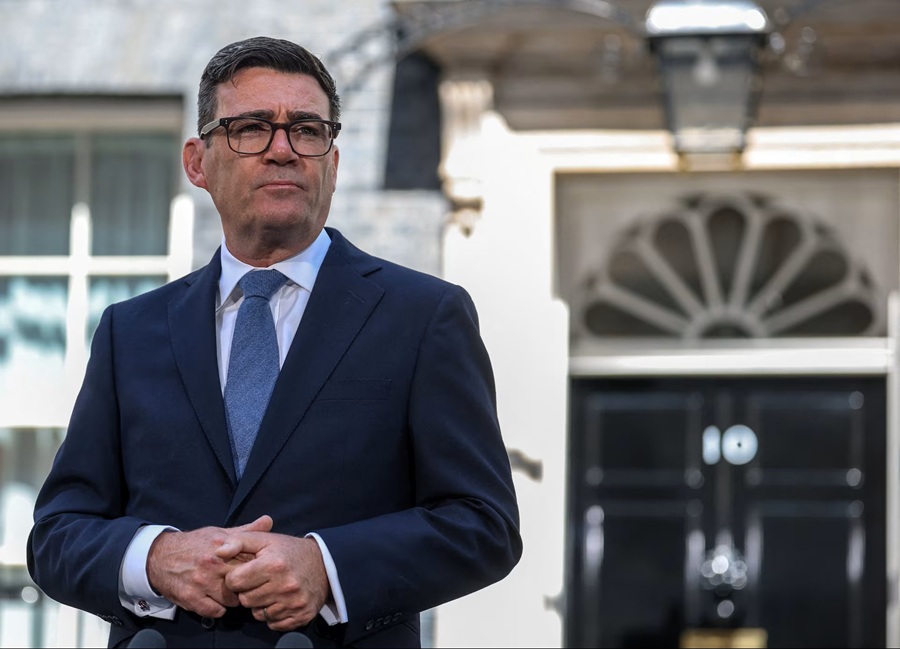
Burnham’s government has maintained that it believes strongly in the Union and has resisted calls for additional independence referendums. His official spokesperson said: “The prime minister is committed to delivering change across all four nations of the United Kingdom and believes strongly in the union.”
The government also rejected the idea that constitutional separation should take precedence over its domestic agenda, saying: “The United Kingdom is at its best when people come together around our shared values and problem-solving, rather than division, and the prime minister will continue to ease pressures on household finances, and delivering greater economic security, rather than engaging in constitutional debates or further referendums.”
The confrontation highlights the central political divide exposed by the Cardiff agreement. The nationalist and pro-unification parties argue that Westminster should facilitate democratic choices over constitutional status, while Burnham’s government maintains that the United Kingdom should remain intact and that its priority is delivering greater powers and economic benefits within the Union.