

Turkiye, Pakistan and Saudi Arabia have taken the first formal steps to institutionalize their new mutual defense arrangement, agreeing to establish a permanent secretariat in Saudi Arabia and deepen military and defense-industrial cooperation.
The decisions were reached on Aug. 31 in Istanbul at the inaugural meeting of the Strategic Political and Defense Committee established under the Mecca Joint Defense Agreement, signed by the three countries in Mecca on Aug. 7.
The meeting brought together the foreign and defense ministers and chiefs of general staff from Turkiye, Pakistan and Saudi Arabia as the three countries seek to translate their political commitment to collective defense into a more structured security framework.
Turkish Foreign Minister Hakan Fidan described the meeting as the first formal institutional step for the alliance.
“Today, together with our Pakistani and Saudi brothers, we formally took the first institutional decisions of the Mecca Defense Alliance at the Strategic Political and Defense Committee meeting we held in Istanbul,” Fidan said in a post on the Turkish social media platform NSosyal.
“We thank all the officials who contributed. May it once again be auspicious for our region,” he added.
Saudi Arabia to host permanent secretariat
Under the joint statement issued after the Istanbul meeting, the three countries agreed to establish a secretariat in Saudi Arabia, headed by a secretary-general, to support implementation of the Mecca Agreement.
“A Secretariat, headed by a Secretary General, will be established in the Kingdom of Saudi Arabia to support their work within the framework of the Mecca Agreement,” the statement said.
The secretariat will initially be headed by a Pakistani secretary-general for a three-year term.
Türkiye, Saudi Arabia and Pakistan are holding their first meeting under the Mecca Defence Agreement in Istanbul. Turkish Foreign Minister Hakan Fidan says the alliance is crucial to strengthening regional security and stability pic.twitter.com/7sHf4LgARw
— TRT World (@trtworld) August 31, 2026
Fidan separately confirmed the arrangement at a news conference following the talks. “There is a secretariat that has been established in Riyadh, and the first secretary-general will be appointed amongst our Pakistani brothers,” he said.
The creation of a permanent administrative structure gives the alliance an institutional mechanism through which its members can coordinate defense policy, military cooperation and future initiatives. The precise responsibilities and operating procedures of the secretariat, however, remain to be developed.
Collective defense at the center of pact
The Mecca Agreement commits the three countries to treating an armed attack against any one of them as an attack against all three.
The arrangement has prompted comparisons with NATO’s collective-defense principle, although the Mecca alliance does not currently possess the integrated command structure, standing forces or joint military machinery that underpin NATO.
The joint statement said the three governments would strengthen their cooperation to improve collective deterrence and defense capabilities.
“Acting with a sense of regional ownership, the three countries reiterate their determination to work together within the framework of the Mecca Agreement to achieve sustainable peace and stability in their region,” the statement said.
“To that end, they will continue to support efforts towards de-escalation and restraint to encourage peaceful resolution of crises,” it added.
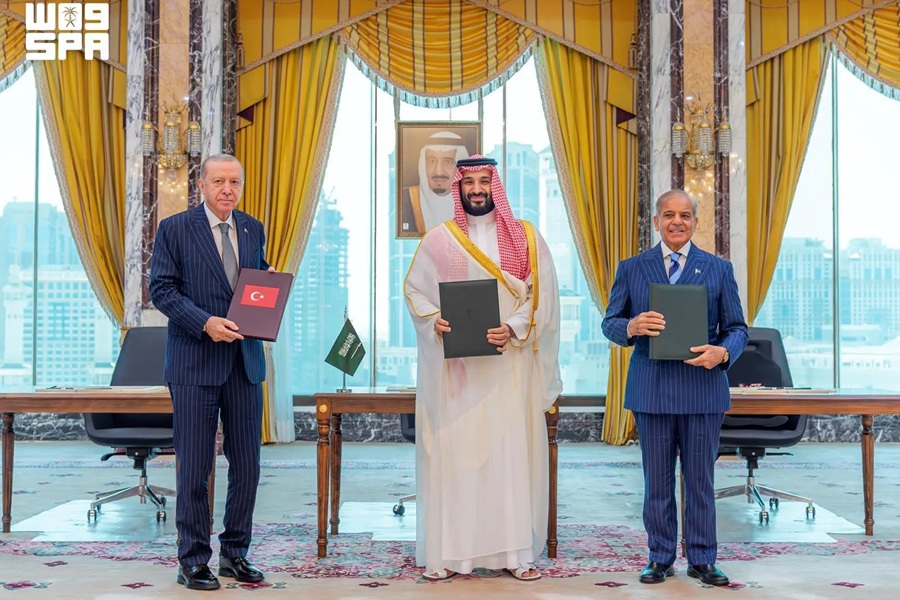
The countries also pledged to institutionalize cooperation “in a manner that would enhance their solidarity, ensure the credibility and effectiveness of their collective deterrence and defense, and contribute to the regional efforts and cooperative security towards a just, inclusive and lasting peace.”
Military interoperability and defense industry cooperation
The three countries agreed to strengthen the capabilities and cohesion of their armed forces through expanded joint activities.
“Through joint activities, they will also work to strengthen their defense capabilities and cohesion of their armed forces through robust defense industry cooperation, joint technology development and production,” the statement said.
The agenda for the Istanbul meeting included military interoperability, joint exercises, defense-industrial cooperation, joint production and research, as well as counterterrorism coordination and broader international security issues.
The three governments said that implementing the agreement would contribute to wider regional stability.
Through the “institutionalized and resolute implementation” of the Mecca Agreement, the three countries would “provide essential contributions to regional peace and stability.”
Alliance remains open to expansion
Fidan said the alliance was based on “international principles, such as respecting the sovereignty of other states, territorial integrity and not intervening in internal affairs” and remained “open for the partnership and participation of any other country” in the region.
The possibility of expansion has already emerged as a key issue for the new grouping.
Pakistan’s Foreign Minister Muhammad Ishaq Dar said during a visit to the United Kingdom over the weekend that six to seven Muslim-majority countries had expressed interest in joining the defense pact, although he did not identify them.
Turkish President Recep Tayyip Erdogan also said in August that Egypt could potentially join the alliance. Fidan’s reference to an accession road map indicates that the founding members are considering how a broader membership structure could operate.
Any expansion would potentially transform the pact from a three-country mutual defense arrangement into a wider regional security framework, although questions remain over the commitments prospective members would undertake and how an enlarged alliance would make collective decisions.
Pact takes shape amid renewed US-Iran tensions
The Istanbul meeting came as renewed hostilities between the United States and Iran underscored the security pressures facing the region.
The Mecca Agreement was signed on Aug. 7, following months of heightened regional tensions. Its first high-level institutional meeting therefore comes as the three founding members seek to establish practical mechanisms for cooperation while operating in an increasingly volatile strategic environment.
The latest exchanges have also raised questions about the extent to which the new alliance could influence regional deterrence and crisis management.
The United States struck two Iranian rocket launchers on Iran’s Larak Island on Aug. 30, according to the supplied reporting, marking the first such U.S. attack since July. Iran’s Islamic Revolutionary Guard Corps subsequently fired ballistic missiles toward U.S. bases in Jordan and claimed a drone attack on Al Minhad Air Base in the United Arab Emirates.
Jordan said it intercepted eight Iranian missiles that entered its airspace, while the UAE said it engaged an Iranian drone over its territorial waters but denied that Al Minhad was attacked.
The IRGC also said an oil tanker attempting to use an “illegal route” through the Strait of Hormuz caught fire after striking two sea mines. The developments added pressure to a strategic waterway that has faced disruption since the conflict began on Feb. 28.
Brent crude rose more than 3% on Aug. 31 to reach $90.97 a barrel, according to the supplied reporting, reflecting the wider economic implications of instability around the Strait of Hormuz.
From political declaration to operational framework
The central challenge for the Mecca defense alliance now is converting its collective-defense commitment into operational arrangements.
The establishment of the Saudi-based secretariat provides the first permanent institutional mechanism, while the Strategic Political and Defense Committee creates a senior political and military forum for coordination.
Further work is expected to determine how the alliance would coordinate intelligence, training, logistics, military exercises and defense production, as well as the circumstances and procedures under which the mutual-defense commitment would be activated.
Retired Brigadier Tughral Yamin, a senior associate at Islamabad’s Institute of Policy Studies, argued that a permanent administrative mechanism was necessary for the pact to become operational.
The three founding members have also emphasized defense-industrial cooperation, including joint technology development and production. Such cooperation could become one of the alliance’s most consequential practical areas as Türkiye, Pakistan and Saudi Arabia seek to strengthen domestic defense capabilities and reduce vulnerabilities in critical military supply chains.
For now, the Istanbul meeting marks the transition from a newly signed political agreement toward an institutional framework. The secretariat, three-year Pakistani leadership and planned expansion of military cooperation give the Mecca Defense Alliance its first tangible organizational structure. Its credibility as a collective-defense arrangement will ultimately depend on how effectively those institutions translate political commitments into coordinated capabilities and credible deterrence.