

VIENNA, Sept. 18, 2026: Pakistan and the International Atomic Energy Agency (IAEA) have signed a safeguards agreement for the 1,200 MW(e) Chashma-5 (C-5) nuclear power plant, establishing the framework for IAEA safeguards at the new reactor being built with Chinese technology.
Pakistan Atomic Energy Commission Chairman Dr. Raja Ali Raza Anwar and IAEA Director General Rafael Mariano Grossi signed the agreement at IAEA headquarters in Vienna on the sidelines of the agency’s 70th General Conference (Sept. 14 – 18). China Atomic Energy Authority’s chairman Shan Zhongde witnessed the ceremony.
The agreement for the application of safeguards at Unit-5 of the Chashma Nuclear Power Plant was unanimously approved by the IAEA Board of Governors in March 2026. The IAEA Board approved the agreement on March 4, 2026, according to Pakistan’s Foreign Ministry. The signing marks the next stage toward implementing safeguards at the facility.
The arrangement forms part of Pakistan’s existing system of item-specific safeguards agreements with the IAEA. The IAEA identifies Pakistan and two other countries as states that are not parties to the Nuclear Non-Proliferation Treaty and have item-specific safeguards agreements with the agency.
Chashma-5 Construction Advances
Construction of Chashma-5, or C-5, is progressing at the Chashma nuclear complex in Mianwali, Punjab. The project has reached several major construction milestones, including the early completion of the reactor building dome placement.
The first concrete for the unit was poured in December 2024. A ceremonial launch attended by Chinese and Pakistani officials followed in early January 2025.
PAEC says the 1,200 MW(e) unit is scheduled for commissioning in 2028. The reactor is expected to add a substantial source of low-carbon and low-cost electricity to Pakistan’s national grid and contribute to energy security, climate objectives and sustainable economic growth.
Pakistan’s Foreign Ministry had previously cited 2030 as the expected operational timeframe. The 2028 date is therefore best presented as PAEC’s current commissioning target rather than as an independently established completion date.
The unit will use the HPR1000, also known as the Hualong One, pressurized water reactor design. The design features both active and passive safety systems and a double-shell containment structure.
Chinese Technology and Financing
China has a central role in the development of C-5, continuing a longstanding civilian nuclear cooperation relationship between Beijing and Islamabad.
PAEC and China National Nuclear Corporation (CNNC) signed a cooperation agreement for Chashma-5 in November 2017. Pakistan and China subsequently advanced the project through a series of agreements and construction milestones, with the groundbreaking ceremony held at the Chashma site in July 2023.
The project is being built by China National Nuclear Corporation and its subsidiary, CNNC China Zhongyuan Engineering Corp., under a cooperation agreement with PAEC.
The project was estimated to cost approximately $4.8 billion, with much of the financing provided through Chinese credit.
The Hualong One is a third-generation pressurized water reactor design developed by China. Pakistan’s Nuclear Regulatory Authority identifies active and passive safety systems and double-shell containment among the design’s safety features.
The Chashma site, also referred to as Chasnupp, is already home to four Chinese-supplied CNP-300 pressurized water reactors, which were connected to the grid between 2000 and 2017.
Expansion of Pakistan’s Nuclear Fleet
C-5 will be Pakistan’s largest individual nuclear power unit, with a gross capacity of 1,200 MW(e).
The four existing Chashma reactors were supplied by China and connected to the grid between 2000 and 2017. Pakistan also operates two Hualong One reactors at the Karachi Nuclear Power Plant.
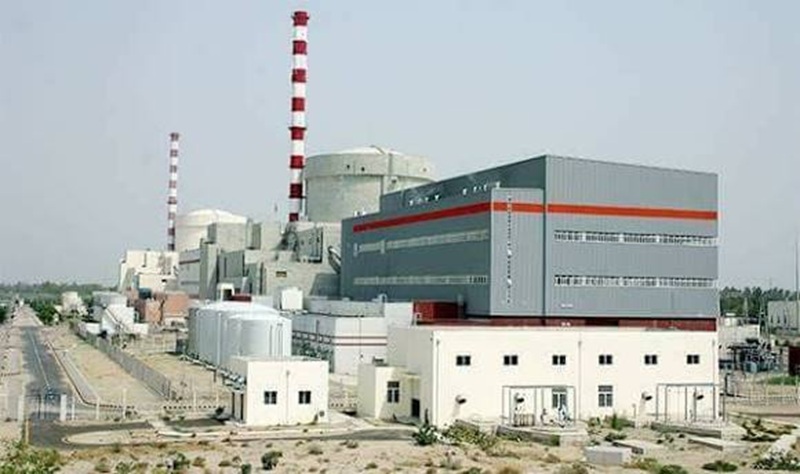
Together, Pakistan’s six operating nuclear power units have a combined installed capacity of 3,530 MW(e). PAEC says the fleet has maintained an average capacity factor exceeding 90%.
Pakistan also has more than 100 reactor-years of operational experience, according to PAEC.
The addition of C-5 would further expand Pakistan’s nuclear generating capacity and the role of nuclear power in the country’s electricity system.
IAEA Safeguards and Non-Proliferation
The safeguards agreement provides the legal framework for IAEA verification at C-5.
IAEA safeguards are designed to verify that nuclear material and facilities covered by an agreement are being used for peaceful purposes. For Pakistan, safeguards are applied under item-specific agreements rather than the comprehensive safeguards agreements that apply to non-nuclear-weapon states party to the NPT.
Pakistan’s safeguards framework consists of item-specific agreements covering specified nuclear material, facilities and activities. The IAEA’s safeguards database lists multiple such agreements with Pakistan, including arrangements covering nuclear power facilities supplied by China.
The C-5 agreement adds another facility to that framework as Pakistan expands its civilian nuclear power capacity.
Pakistan-China Nuclear Cooperation
The safeguards signing came during a broader round of Pakistani and Chinese engagement at the IAEA General Conference.
Earlier, a bilateral meeting between Pakistani and Chinese delegations focused on ongoing and future cooperation in the peaceful applications of nuclear science and technology.
Anwar led the Pakistani delegation, while Zhongde headed the Chinese delegation. Mohammad Kamran Akhtar Malik, Pakistan’s ambassador to Austria and permanent representative to the IAEA, also participated in the discussions.
Anwar also served as a keynote speaker at two high-level side events organized by the China Atomic Energy Authority, the Permanent Mission of China in Vienna and Chinese organizations working in nuclear science and its peaceful applications.
With the safeguards agreement now signed, C-5 has moved into the next stage of its regulatory process as construction continues toward the commissioning target set by PAEC.