

The U.S. State Department has approved a potential $24.3 billion Foreign Military Sale of F-35 Lightning II fighter aircraft and related equipment to Saudi Arabia, advancing Riyadh’s effort to acquire the advanced U.S. stealth fighter.
The State Department’s Sept. 17 notification covers 48 F-35A aircraft, the conventional takeoff and landing version of the F-35, and 49 Pratt & Whitney F135-PW-100 engines, including 48 installed engines and one spare.
The package also includes secure communications and cryptographic equipment, electronic warfare database support, spare parts, training systems and simulators, software, technical documentation, maintenance support, transportation and other logistical services.
The announcement comes as Saudi Arabia faces a renewed escalation with Iran-backed Houthi forces in Yemen and amid a wider regional conflict that has put the kingdom’s territory and energy infrastructure under increasing pressure. On Sept. 8, Houthi forces attacked several Saudi cities, including Abha, Khamis Mushait, Jizan and Najran, with Saudi authorities reporting 73 people wounded. The strikes also triggered fires at oil installations and utility sites, according to Saudi officials.
The latest escalation has also raised concerns over the security of the Red Sea and Bab al-Mandeb, a vital maritime chokepoint. Fighting has intensified along Yemen’s western coast, while Houthi forces have expanded their control around the Red Sea approaches. On Sept. 17, Saudi Arabia and the Houthis exchanged further attacks, with the renewed fighting adding to a humanitarian crisis in Yemen and increasing pressure on regional energy and shipping routes.
Congressional review begins
The notification triggers a 30-day congressional review period. Lawmakers can seek to block the transaction during that period.
The proposed sale has drawn scrutiny over the protection of sensitive F-35 technology and Saudi Arabia’s growing relationship with China. Recent reporting has cited U.S. intelligence concerns that Chinese access to Saudi facilities or technology could create risks for sensitive U.S. defense technology. Members of Congress have also raised concerns about the transfer.
The State Department’s Sept. 17 notification does not cite China or detail those intelligence concerns in its justification for the sale.
Washington cites Saudi defense and regional security
The State Department said the proposed transaction would strengthen Saudi Arabia’s defensive capabilities and improve interoperability with U.S. and allied forces.
“This proposed sale will support the foreign policy and national security objectives of the United States by improving the security of a major non-NATO ally that is a force for political stability and economic progress in the Gulf region.”
The department said the F-35s would improve Saudi Arabia’s ability to deter current and future threats, strengthen homeland defense and enhance interoperability with U.S. forces, regional forces and NATO forces.
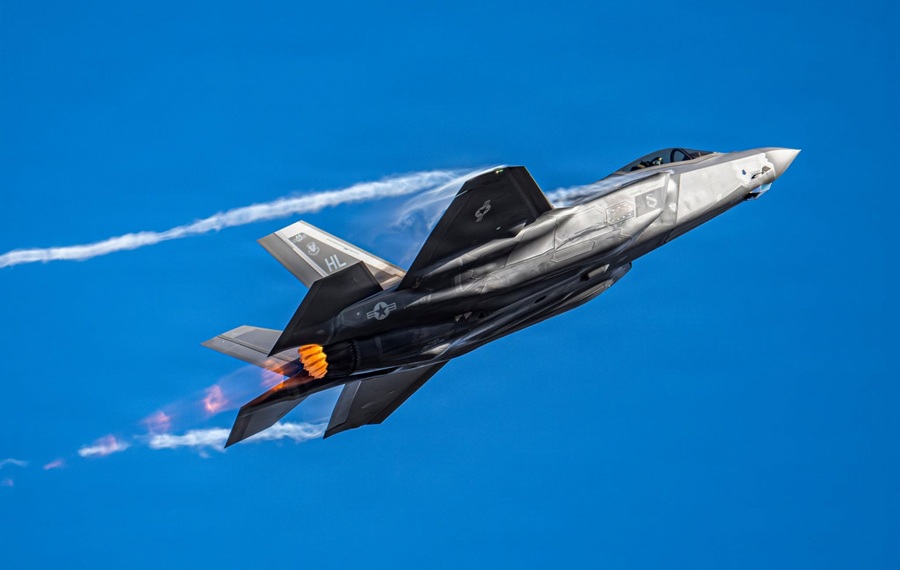
The notification also says the aircraft would augment Saudi Arabia’s operational fleet and improve its air-to-air and air-to-ground self-defense capabilities.
“The proposed sale of this equipment and support will not alter the military balance in the region.”
The State Department said Saudi Arabia would have no difficulty absorbing the equipment and services into its armed forces. It also said the transaction would not require additional U.S. government or contractor representatives to be assigned to Saudi Arabia and would have no adverse impact on U.S. defense readiness.
Lockheed Martin welcomes the agreement
Lockheed Martin Aeronautics Company, based in Fort Worth, Texas, and Pratt & Whitney Military Engines, based in East Hartford, Connecticut, are identified as the principal contractors.
Lockheed Martin said the proposed agreement reflected the broader U.S.-Saudi security relationship. “The government-to-government agreement to provide F-35 aircraft exemplifies our shared commitment to enduring security, stability, and long-term cooperation.”
The company also said the aircraft’s capabilities “directly support” Saudi Arabia’s “Vision 2030.”
“Lockheed Martin looks forward to continued collaboration as the U.S. Congressional review process advances,” the company said.
Pratt & Whitney referred questions about the proposed sale to the Pentagon’s F-35 Joint Program Office.
Technology and regional balance concerns
The potential transfer has implications beyond the U.S.-Saudi defense relationship because of the sensitivity of F-35 technology and the aircraft’s role in the regional military balance.
Israel is currently the only Middle Eastern operator of the F-35. U.S. law requires Washington to take Israel’s qualitative military edge into account when approving major arms transfers to other countries in the region.
The State Department’s notification does not provide a detailed explanation of its assessment regarding Israel’s qualitative military edge. It states instead that the proposed sale “will not alter the military balance in the region.”
The department also said it was not aware of any offset agreement proposed in connection with the potential sale. Any offset arrangement would be defined through negotiations between Saudi Arabia and the contractor.
Major expansion of Saudi airpower
The F-35 acquisition would give Saudi Arabia access to an advanced U.S. combat aircraft and deepen its military integration with Washington.
The proposed package includes the aircraft and engines as well as the training, maintenance, software, communications and logistical infrastructure required to operate and sustain the fleet.