

Foreign ministers from eight European and regional countries met in Istanbul to address mounting security challenges, prevent further military escalation in the Middle East, and expand cooperation on regional conflicts, maritime security, and the protection of global trade routes.
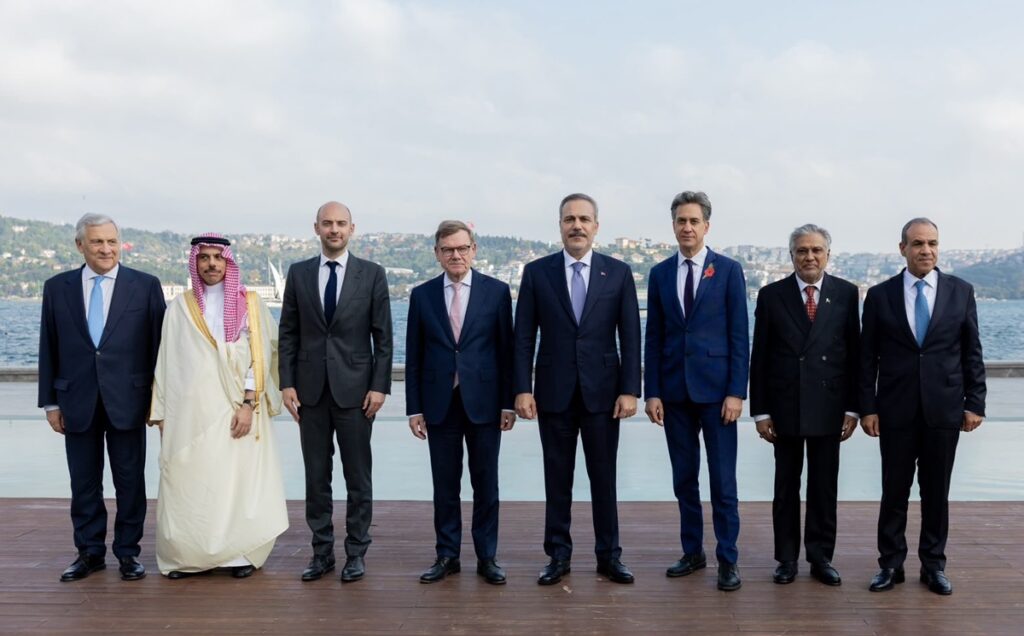
The meeting brought together the foreign ministers of Türkiye, Egypt, Pakistan and Saudi Arabia, known as the R4, with their counterparts from Germany, France, the United Kingdom and Italy, the E4. Hosted by Turkish Foreign Minister Hakan Fidan, the gathering marked a new diplomatic format intended to strengthen coordination between European and regional powers over interconnected security crises.
Discussions focused on tensions involving Iran and the United States, Houthi attacks affecting Saudi Arabia and Red Sea shipping, security in the Strait of Hormuz and the Black Sea, and efforts to end the Russia-Ukraine war. The ministers also addressed food security, energy supplies and the economic consequences of disruptions to maritime trade.
The talks came amid concerns about renewed US-Israeli military action against Iran, continuing Houthi attacks on Saudi Arabia and threats to international shipping routes that carry critical energy supplies and agricultural commodities.
Key Highlights
- Eight-nation diplomatic initiative: The R4 and E4 countries met for the first time in this format to coordinate responses to regional and international security challenges.
- Call for de-escalation: Ministers emphasized diplomacy and political solutions to prevent a wider Middle East conflict.
- Maritime security: The Strait of Hormuz, Bab al-Mandab and the Black Sea featured prominently in discussions on freedom of navigation and global trade.
- Support for Saudi Arabia: Egypt reiterated its solidarity with Riyadh, while Pakistan reaffirmed its support for Saudi sovereignty and territorial integrity.
- Food and energy security: Participants highlighted the impact of shipping disruptions on grain exports, fertilizer supplies, energy prices and vulnerable import-dependent countries.
- Continued diplomatic engagement: The participating countries agreed to meet regularly following what French Foreign Minister Jean-Noël Barrot described as “very constructive discussions.”
Eight Nations Seek to Prevent Wider Regional Conflict
The meeting was organized at the initiative of Germany and Türkiye, with Fidan hosting his counterparts from the seven partner countries. Italian participation expanded the established R4+E3 grouping, which comprises Türkiye, Egypt, Pakistan and Saudi Arabia alongside Germany, France and the United Kingdom.
Egyptian Foreign Minister Badr Abdelatty described the gathering as an opportunity for the European participants to join collective efforts to contain regional tensions. According to Egypt’s Foreign Ministry, he emphasized that the meeting reflected a shared recognition of the dangers posed by renewed military escalation and the urgent need to promote peace and stability.
Abdelatty called for an end to escalation, greater reliance on political and peaceful solutions, and stronger dialogue among the parties concerned. He also stressed the importance of breaking the deadlock in negotiations to facilitate the resumption of diplomatic efforts and establish understandings that could help resolve the crisis.
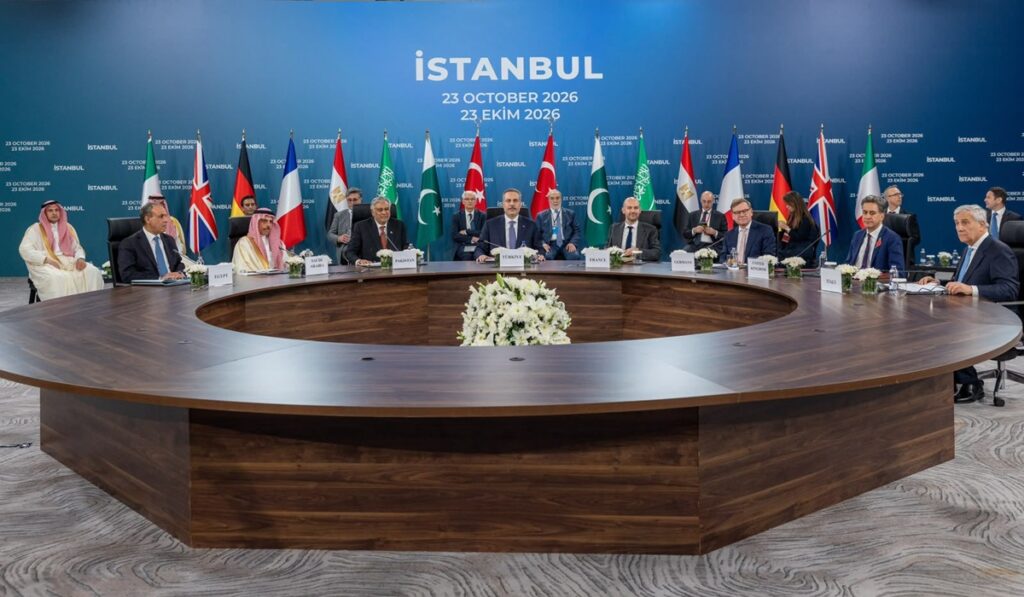
Turkish Foreign Minister Hakan Fidan said the participating countries had agreed to convey a common message to all parties that diplomacy should take precedence over further military confrontation.
“A repeated attack on Iran could spread the war and conflict in the region further,” Fidan told journalists after the talks.
“On the other hand, the opening of the Strait of Hormuz is needed, and the attacks on Saudi Arabia shall also stop.”
Fidan said the ministers had discussed the parameters for preventing the conflict from spreading across the Middle East but declined to elaborate on the details.
French Foreign Minister Jean-Noël Barrot also warned against a new escalation between Tehran and Washington, saying it “would create nothing but losers and would undoubtedly have very serious consequences for hydrocarbon prices”.
Italian Foreign Minister Antonio Tajani argued that military action alone could not resolve the crisis.
“If we want to reopen Hormuz, which is vital for our economies, we must promote dialogue and make Iran understand that this attitude cannot continue.”
Tajani said the participating countries were working toward a joint declaration reflecting their commitment to peace in the Gulf and the wider Middle East.
Strait of Hormuz and Red Sea Security in Focus
Freedom of navigation emerged as a central concern, particularly around the Strait of Hormuz and the Bab al-Mandab Strait, two strategic waterways whose disruption can affect global energy markets and international shipping.
The Strait of Hormuz, between Iran and Oman, is a critical route for global oil shipments. Bab al-Mandab connects the Red Sea with the Gulf of Aden and serves as a major passage for maritime trade between Europe and Asia.
Germany’s Foreign Ministry said approximately one-fifth of the oil consumed globally passes through the Strait of Hormuz, while around 12% of global maritime trade transits Bab al-Mandab.
German Foreign Minister Johann Wadephul warned before departing for Istanbul that the challenges surrounding the Strait of Hormuz, Houthi attacks in Yemen and Saudi Arabia, and growing threats to Black Sea grain shipments required broader international cooperation.
“We, eight countries standing together, are sending a message: We do not accept that Iran and the Houthi militia are blackmailing world trade and continuing to stranglehold global supplies of energy and fertiliser. The wanton attacks on freedom of navigation and on neighbouring countries must end.”
Wadephul’s remarks reflected Germany’s concern that insecurity along shipping routes could raise transportation costs, disrupt supply chains and increase prices for energy and essential goods.
Germany also participates in the European Union-led naval operation EUNAVFOR ASPIDES, which protects commercial shipping in the Red Sea and Gulf of Aden.
Barrot similarly stressed that maritime insecurity has direct economic consequences for European countries.
“Violations of freedom of navigation, whether in the Black Sea or Gulf region, have ‘extremely concrete consequences for us’,” Barrot said, according to the report on the talks.
“They significantly drive up transportation costs, which ultimately leads to inflation – that is, rising prices – and thus a reduction in the purchasing power of French citizens.”
The meeting also addressed the threat posed by Houthi attacks on Saudi Arabia. The attacks have heightened concerns about regional security and maritime traffic, prompting European and regional partners to consider measures to support the kingdom’s defenses and prevent further destabilization.
France has confirmed that it is sending military capabilities to help protect the Yanbu oil export terminal on Saudi Arabia’s western coast. The United Kingdom has also announced plans to deploy fighter jets to help Saudi Arabia defend against the growing threat of Houthi attacks.
Egypt reiterated its full solidarity with Saudi Arabia. Abdelatty emphasized the need to halt attacks on international shipping and ensure the full and safe freedom of navigation.
Pakistan’s Foreign Minister Mohammad Ishaq Dar also met Saudi Foreign Minister Prince Faisal bin Farhan Al Saud on the sidelines of the Istanbul gathering. According to Pakistan’s Foreign Ministry, Dar expressed Islamabad’s “full support” for Saudi Arabia’s sovereignty and territorial integrity.
Food Security and Black Sea Grain Exports
The ministers’ discussions extended beyond immediate military threats to the wider economic and humanitarian consequences of maritime insecurity.
Egypt’s Foreign Ministry said the participants highlighted the pressure that regional and international tensions were placing on food markets and global supply chains. They stressed the need for stronger international coordination to maintain the flow of grain and essential food commodities and mitigate the impact of crises on vulnerable countries, particularly Egypt and other African nations.
The Black Sea remains a major concern because of its role in supplying agricultural commodities to international markets.
Germany’s Foreign Ministry said Russian attacks on civilian vessels and port infrastructure had brought Ukrainian grain exports through the Black Sea to a virtual standstill since July 2026. Before the disruption, around 30% of global wheat trade was shipped through the route, according to the ministry.
The loss of these shipments has increased pressure on alternative supply routes, which Germany said could compensate for only a limited share of the shortfall. Disruptions to grain and fertilizer exports can push up global food prices, particularly affecting countries that depend heavily on imports.
Wadephul warned that attacks on agricultural shipments threatened food security well beyond the immediate conflict zone.
“Russia is now also targeting freedom of navigation in the Black Sea and with it the lifeline for so many people. When Russia attacks grain supplies, it is fully aware that this can lead to food shortages in the Global South. It is the world’s poorest who suffer here, as they are particularly dependent on wheat – but also our partners, for example Turkey, the country that processes the most wheat for global trade.”
Germany backed efforts to establish a ceasefire for civilian shipping, pointing to the 2022 UN-mediated Black Sea Grain Initiative as evidence that agreements can improve food access and ease pressure on international markets.
Tajani also highlighted cooperation with the Rome-based UN Food and Agriculture Organization to protect the international movement of grain, cereals and fertilizers.
For Egypt, the combination of maritime disruption, rising food prices and pressure on supply chains presents a particular concern because of the country’s reliance on imported food commodities.
Türkiye and Italy Promote Diplomatic Coordination
The Istanbul meeting also reflected efforts by Türkiye and Italy to strengthen diplomatic engagement between European and regional powers.
Fidan described the informal format as a way to encourage open discussion and develop practical responses to shared challenges.
“The most important feature of our platform is that it’s informal, flexible, allows for the free expression of our ideas, the creation of policies around these ideas, and the determination of concrete action steps if necessary,” he said.
Barrot said the ministers had agreed to continue meeting at regular intervals after their initial discussions.
Italy’s Tajani welcomed the initiative before departing for Istanbul, describing it as an opportunity to bring European and regional governments together to address ongoing conflicts.
“The initiative of the Turkish government and Foreign Minister Hakan Fidan is timely and productive. Rome supports the idea of bringing together European and regional countries to discuss the conflicts in the Middle East,” Tajani said.
He also reaffirmed Italy’s support for negotiations aimed at achieving a just and lasting peace between Russia and Ukraine.
“Disputes and rivalries must be resolved through diplomacy, not weapons,” he stated.
The talks included efforts to revive the Yemen peace process, preferably under United Nations auspices, and address the humanitarian situation in Gaza. Tajani reiterated Italy’s support for a two-state solution to the Israeli-Palestinian conflict and called for continued humanitarian assistance to the Gaza Strip.
The ministers also considered the implications of the Russia-Ukraine war for European and regional security, with Fidan calling for a ceasefire and peace agreement in Ukraine as soon as possible.
A New Platform Amid Overlapping Security Crises
The Istanbul gathering took place as the participating countries confronted overlapping security challenges involving military escalation, maritime trade, energy supplies and food security.
For European governments, threats to shipping routes carry direct consequences for energy prices, inflation and access to essential commodities. For regional powers, the risks extend to national security, the stability of neighboring countries and the potential spread of conflict.
The meeting also brought together countries with differing diplomatic relationships and security priorities, making sustained coordination an important test for the new format.
Fidan said all participating countries opposed the further spread of war in the Gulf and Ukraine, while emphasizing the central role of diplomacy.
“All countries believe that diplomacy and dialogue are the only way forward,” he said.
“There is a huge room for diplomacy, but also a huge room for war. It depends especially on the stance that the relevant actors, the states in the region, and some global actors will take”
The agreement to meet regularly provides a framework for continued consultation. However, the Istanbul meeting did not, in the supplied reports, produce a detailed public plan for reopening the Strait of Hormuz, ending Houthi attacks or securing a ceasefire in the Black Sea.
Its immediate outcome was a shared commitment to diplomatic engagement and closer coordination among eight countries seeking to limit the consequences of a widening regional crisis.