

China and the International Atomic Energy Agency have signed a cooperation agreement on high-temperature gas-cooled reactor technology, establishing a framework for technical exchanges that could broaden international access to China’s engineering experience in advanced nuclear systems.
The agreement was signed by Chinergy Co Ltd, a subsidiary of China National Nuclear Corporation (CNNC), and the IAEA in Vienna on Sept. 14, as the agency’s 70th General Conference opened. A Chinese exhibition focused on small modular reactors and the integrated use of nuclear energy also opened alongside the conference.
IAEA Director General Rafael Mariano Grossi, China Atomic Energy Authority Director Shan Zhongde, China’s Permanent Representative to the IAEA Ambassador Li Song, and CNNC General Manager Zhang Tao were among officials who witnessed the signing.
According to CNNC, Grossi was briefed on China’s advanced nuclear technologies, including high-temperature gas-cooled reactors (HTGRs) and the Linglong One, also known as ACP100 small modular reactor, as well as their applications.
Agreement Covers Reactor Development and Operations
Under the agreement, Chinergy and the IAEA will cooperate and exchange information on the research and development, design, construction, commissioning and operation of HTGR nuclear power plants.
The cooperation will also cover supply chains and personnel training, according to CNNC.
The arrangement comes as countries examine advanced nuclear technologies for applications extending beyond conventional electricity generation. HTGRs operate at higher temperatures than conventional reactors, creating potential applications for industrial heat, steam production and hydrogen generation in addition to electricity.
CNNC said the agreement would allow countries to gain access to China’s practical experience in HTGR engineering and support wider international use of the technology in applications including power generation, industrial heat supply and hydrogen production.
The agreement itself does not establish plans for deploying Chinese HTGR reactors in other countries. Rather, it provides a framework for technical cooperation, information exchange and the sharing of engineering experience.
HTGR Explained
An HTGR, or high-temperature gas-cooled reactor, is an advanced nuclear reactor that uses a gas, typically helium, to carry heat away from the reactor core and is designed to operate at higher temperatures than conventional reactors. That heat can be used to generate electricity and to provide high-temperature steam and heat for industrial processes.
HTGRs can also support hydrogen production, giving the technology potential applications beyond conventional power generation, including supplying heat to energy-intensive industries and helping reduce their use of fossil fuels.
China’s HTGR Experience
China has been developing HTGR technology for both electricity generation and industrial applications. Its HTR-PM demonstration project at Shidao Bay in Shandong uses two small reactor modules linked to a single steam turbine and entered commercial operation in 2023.
CNNC has also been pursuing advanced nuclear technologies that can support industrial processes requiring large quantities of heat.
The company’s work includes small modular reactors and fourth-generation reactor technologies, alongside efforts to integrate nuclear energy with industrial sectors such as petrochemicals.
The approach reflects a broader effort to expand nuclear energy applications beyond grid electricity. Industrial heat, hydrogen production, regional heating, desalination and other applications are being explored as potential uses for nuclear energy.
Xuwei Project Links Nuclear Energy to Petrochemical Industry
A major example is the Xuwei Nuclear Heating and Power Plant in Jiangsu Province, where construction of the project’s nuclear island began on Jan. 16, 2026.
CNNC describes Xuwei as the world’s first large-scale nuclear energy and petrochemical industry integration project. The facility combines pressurized water reactor technology with an HTGR and is designed primarily to provide industrial heat, with electricity generation as a secondary output.
Phase I comprises two Hualong One units and one HTGR. CNNC said the phase is expected to supply 32.5 million tonnes of industrial steam annually once operational, while generating more than 11.5 billion kilowatt-hours of electricity at peak output.
The project is intended to serve the Lianyungang Petrochemical Industrial Base, where industrial processes require substantial quantities of heat.
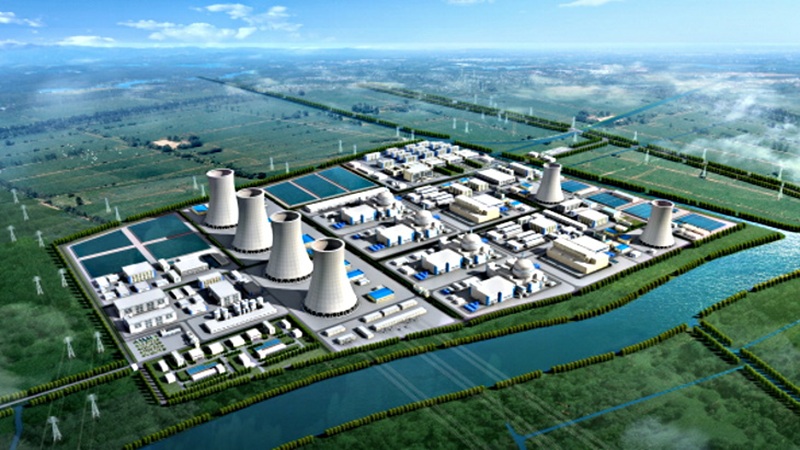
CNNC subsequently said the broader nuclear-petrochemical coupling base in Lianyungang is expected to supply more than 35 million tonnes of industrial steam annually once its first phase is completed. That broader figure includes the Xuwei plant and the CNNC Heqi-1 steam supply system.
The distinction is significant: the 32.5-million-ton figure applies to Phase I of the Xuwei project, while the more than 35-million-ton figure refers to the wider nuclear-petrochemical coupling base.
Nuclear Heat Gains International Attention
The development of industrial nuclear heat comes as governments consider nuclear power as part of strategies aimed at strengthening energy security and reducing carbon emissions.
HTGRs are particularly relevant to such applications because their operating temperatures can support industrial processes that require high-quality heat. This creates a potential role for advanced reactors in sectors where electrification alone may be difficult or costly.
For China, the agreement with the IAEA provides an international mechanism for sharing experience gained through the country’s advanced nuclear program. For the IAEA, the cooperation adds to its work on advanced reactor technologies and the broader applications of nuclear energy.
The agreement also places China’s HTGR development within a wider international discussion over the future role of advanced nuclear technologies, particularly where reactors can provide both electricity and industrial heat.
As countries explore new nuclear technologies, the ability to demonstrate reliable reactor operation, establish supply chains, develop trained personnel and integrate nuclear systems with industrial infrastructure will remain central to their potential deployment.
China’s experience with the HTR-PM and its ongoing Xuwei project gives the HTGR cooperation agreement a practical engineering dimension, while the IAEA framework provides a channel through which that experience can be exchanged with the international nuclear community.