

Pakistan has brought together representatives from 49 countries for a four-day International Atomic Energy Agency (IAEA)-backed meeting on nuclear security, highlighting its growing engagement in international cooperation, technical capacity building and the development of indigenous security technologies.
The 15th annual meeting of the International Network for Nuclear Security Training and Support Centres (NSSC Network), which opened in Islamabad on November 23, has attracted approximately 68 delegates, including policymakers, nuclear regulators, academics and technical experts.
Organized at the Pakistan Centre of Excellence for Nuclear Security (PCENS) in collaboration with the IAEA, the gathering runs through November 26 and provides a platform for participating countries to exchange technical expertise, strengthen institutional capabilities and address emerging challenges in nuclear security.
The meeting also marks the network’s return to Islamabad after a decade. Pakistan previously hosted the annual gathering in 2016, becoming the first country outside the IAEA headquarters in Vienna to organize the event.
IAEA Highlights Role of Nuclear Security Cooperation
In a video address to the opening session, IAEA Director General Rafael Mariano Grossi thanked Pakistan for hosting the meeting and highlighted the network’s contribution to strengthening practical nuclear security capabilities worldwide.
“The NSSC Network plays an active and crucial role in turning nuclear security from theory into effective practice,” Grossi said.
“That is especially important as more and more countries turn to nuclear power and other nuclear applications for everything from electricity and heat to medicine and hardier crops.”
The NSSC Network connects national Nuclear Security Support Centres to facilitate cooperation in training, technical support, knowledge sharing and the development of sustainable nuclear security capabilities.
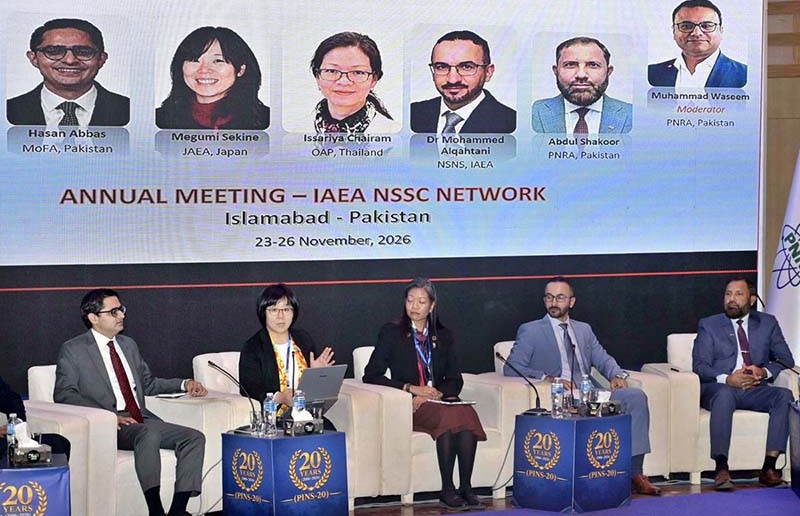
Its annual meeting provides an opportunity for member countries to review ongoing initiatives, exchange experience and coordinate efforts to strengthen national nuclear security frameworks.
Discussions during this year’s gathering include nuclear security training programs, technical exchanges, regional cooperation and the network’s future priorities. Participants are also expected to select new network leadership and develop action plans for 2026–2027.
Pakistan Reaffirms Commitment to Nuclear Security
Addressing the opening session, Additional Foreign Secretary Ambassador Khalil Hussain Hashmi reaffirmed Pakistan’s commitment to nuclear security and its longstanding partnership with the IAEA.
He described the meeting’s return to Islamabad after 10 years as a reflection of the network’s expanding international reach and relevance.
Hashmi emphasized that effective nuclear security depends on strong national institutions, qualified professionals and sustained international cooperation, while underscoring the IAEA’s central role in the international nuclear security framework.
Pakistan Nuclear Regulatory Authority (PNRA) Chairman Zia Hussain Shah, who formally inaugurated the gathering, highlighted the importance of developing specialized human resources to sustain improvements in nuclear security.
He said the NSSC Network had evolved into a valuable international platform for strengthening professional competencies, promoting knowledge sharing and supporting long-term capacity building.
Shah also acknowledged Pakistan’s contributions to the network through its national institutions and emphasized the importance of continued investment in training and technical expertise.
Following the opening session, diplomats and IAEA representatives toured the PCENS laboratories, where they reviewed the facility’s nuclear security training infrastructure. Delegates are also scheduled to visit the National Institute of Safety and Security and the Pakistan Institute of Engineering and Applied Sciences during the meeting.
Pakistan and IAEA Mark 20 Years of Nuclear Security Cooperation
The annual meeting coincided with a separate event marking two decades of cooperation between Pakistan and the IAEA in nuclear security, highlighting progress in institutional development, specialized training and indigenous technological innovation.
Held at the PNRA on November 24, the event brought together senior government officials, IAEA representatives, international delegates, diplomats, nuclear industry representatives, technology developers and research institutions.
PNRA Chairman Zia Hussain Shah said the partnership had helped strengthen Pakistan’s nuclear security infrastructure, develop skilled human resources and build institutional capabilities over the past 20 years.
He also highlighted the development of indigenous technologies and innovation, noting that cooperation had created opportunities for Pakistani industry to engage with the international nuclear security community.
IAEA Deputy Director General and Head of the Department of Nuclear Safety and Security Karine Herviou commended Pakistan’s longstanding partnership with the Agency, describing it as a reflection of their shared commitment to advancing nuclear security through international cooperation and capacity building.
An exhibition of nuclear security technologies, equipment and technical solutions developed by Pakistan’s national industry formed a key part of the event. It provided an opportunity for international delegates, IAEA representatives and domestic technology developers to explore technical collaboration and exchange expertise.
The exhibition also highlighted Pakistan’s efforts to develop indigenous capabilities in support of its nuclear security infrastructure.
Nuclear Technology and Pakistan’s International Engagement
Pakistan’s engagement with the IAEA also extends to the peaceful applications of nuclear science, including electricity generation, healthcare and scientific education.
The Pakistan Atomic Energy Commission (PAEC) operates six nuclear power plants with a combined generation capacity exceeding 3,500 megawatts (MW), according to PAEC Chairman Dr Raja Ali Raza Anwar. The commission also operates 21 cancer hospitals that provide diagnosis and treatment services to around 80% of the country’s cancer patients.
In a related initiative, Pakistan and the IAEA are conducting a regional workshop in Islamabad from November 23 to 27 to strengthen nuclear science education and prepare for the fourth International Nuclear Science Olympiad (INSO), which Pakistan will host in 2027.
The workshop has attracted trainers from 22 countries, with five IAEA experts delivering sessions on student selection, training, mentorship and educational methodologies.
Pakistan’s participation in these initiatives reflects the broader scope of its engagement with the Agency, spanning nuclear security, technical cooperation, scientific education and the peaceful use of nuclear technology.
As the NSSC Network meeting concludes on November 26, its discussions are expected to contribute to continued international collaboration on nuclear security training, institutional development and technical capacity building.
For Pakistan, hosting the gathering for a second time after 10 years provides an opportunity to demonstrate its institutional capabilities, showcase domestic technological development and reinforce its role in international nuclear security cooperation.