

The U.S. Army has selected five companies to develop nuclear microreactors at five military installations, committing up to $2.2 billion in government funding as Washington seeks to strengthen military energy resilience and reduce dependence on vulnerable power grids.
The Army announced the selections Aug. 26 under its Janus Program, which is being pursued in partnership with the Department of War Innovation Unit. The service expects private-sector investment alongside government funding and ultimately aims to deploy more than 20 nuclear microreactors across Department of War installations.
The Army is awarding up to a combined $2.2 billion to own, construct, and operate nuclear microreactors on military installations. The agreements will use Other Transactions Authority mechanisms and milestone-based payments, with government funding tied to the successful completion of specified technical objectives. The prototype reactors will be contractor-owned and operated.
The five companies and initial sites are:
- Antares Nuclear, Inc.: Fort Bragg, North Carolina
- BWXT Advanced Technologies, LLC: Fort Campbell, Kentucky
- General Atomics Electromagnetic Systems: Fort Hood, Texas
- Radiant Industries, Inc.: Fort Benning, Georgia
- Westinghouse Government Services: Fort Drum, New York
The agreements will use Other Transactions Authority mechanisms and milestone-based payments. The reactors will be contractor-owned and operated, with government funding tied to the successful completion of specified technical objectives.
Energy Security for Military Installations
The Army is pursuing microreactors as a source of resilient baseload power that can support critical military infrastructure if commercial electricity supplies are disrupted.
“Since launching the Janus Program, our mandate from President Trump and Secretary Hegseth has been clear: secure the power our warfighters need to train, deploy and win,” said Dan Driscoll, Secretary of the Army. “Awarding these contracts accelerates our ability to deliver safe, reliable baseload power directly to our installations. We are building the energy resilience necessary to project combat power globally, without relying on potentially vulnerable external grids.”
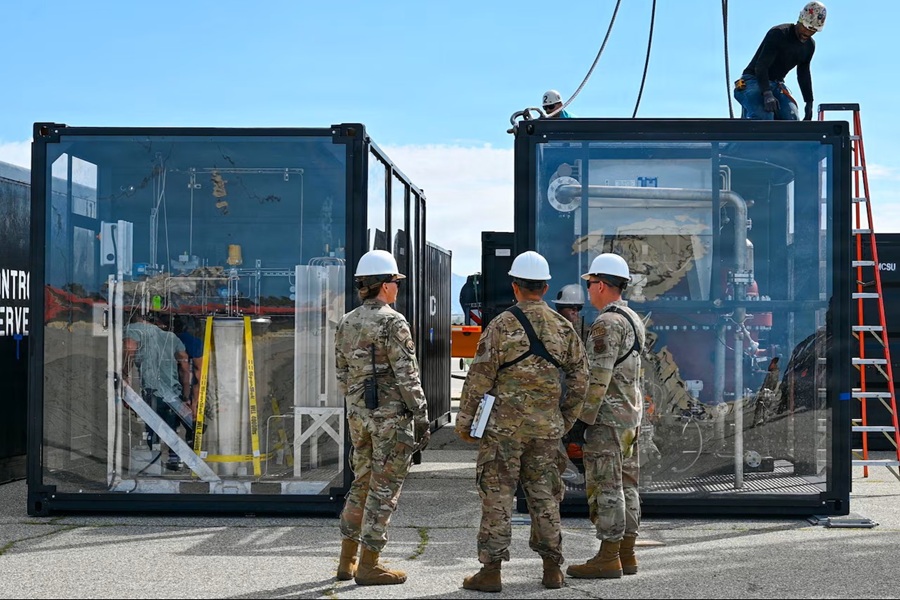
Army officials have warned that military installations remain dependent on commercial electricity networks and liquid-fuel supplies, creating potential vulnerabilities during conflict.
“Unlike in prior conflicts, we now know that our domestic electric grid is potentially at risk in a conflict,” said Dr. Jeff Waksman, principal deputy assistant secretary of the Army for Installations, Energy and Environment. “We also know that we will not necessarily be able to move fossil fuels easily wherever we need them to go. Right now, all critical infrastructure that the Army has is backed up by some form of liquid fossil fuel, primarily diesel.”
The concern also applies to remote overseas facilities.
“We’re often dependent. In a lot of our Pacific islands, we’re dependent on foreign-shipped fuel from foreign-flagged vessels, and that doesn’t give us a lot of comfort if there were to be a future conflict,” Waksman continued.
The initial installations are expected to remain connected to commercial power grids under normal conditions. The microreactors are intended to add resilient generation rather than immediately replace grid electricity across entire bases.
From Project Pele to Janus
The Army launched Janus to move advanced nuclear technology beyond demonstrations and toward systems capable of producing reliable power over extended periods.
“The Janus Program is grabbing the baton from Project Pele and the [Department of Energy’s] Reactor Pilot Program,” Waksman said. “We are seeking not just reactors capable of turning on for a brief demonstration, but rather systems able to deliver power with high-capacity factors for years of operation. The Janus Program will be a complete success when and only when we have assisted multiple nuclear companies in developing truly reliable and affordable nuclear microreactors which they can sell to other buyers beyond just the military.”
The Army says the program is intended to help establish commercially viable nuclear technologies rather than create reactors designed solely for military use.
Government funding will total approximately $2.2 billion across fiscal years 2027 through 2031, with substantial additional capital expected from participating companies.
“We need more power. We need it delivered faster and cheaper, and we need it to be more reliable,” said Owen West, director, DIU. “With Janus, DIU is assisting the Army’s micro reactor build — speeding military energy production to protect the nation.”
2028 Reactor Target
The Army is working toward a Sept. 30, 2028, target for operation of its first Army-regulated nuclear reactor at a military installation, pursuant to President Trump’s Executive Order 14299.
The selected technologies will undergo technical development, testing and site-planning activities before potential deployment. Fort Hood, for example, will support development and testing of General Atomics’ Tactical Energy System, or GA-TES, toward potential deployment.
General Atomics says GA-TES has a baseline net output of approximately 5 megawatts electric and can scale to approximately 20 megawatts electric. The company designed the system for transport by truck or rail and says it uses pump-free natural-circulation cooling.
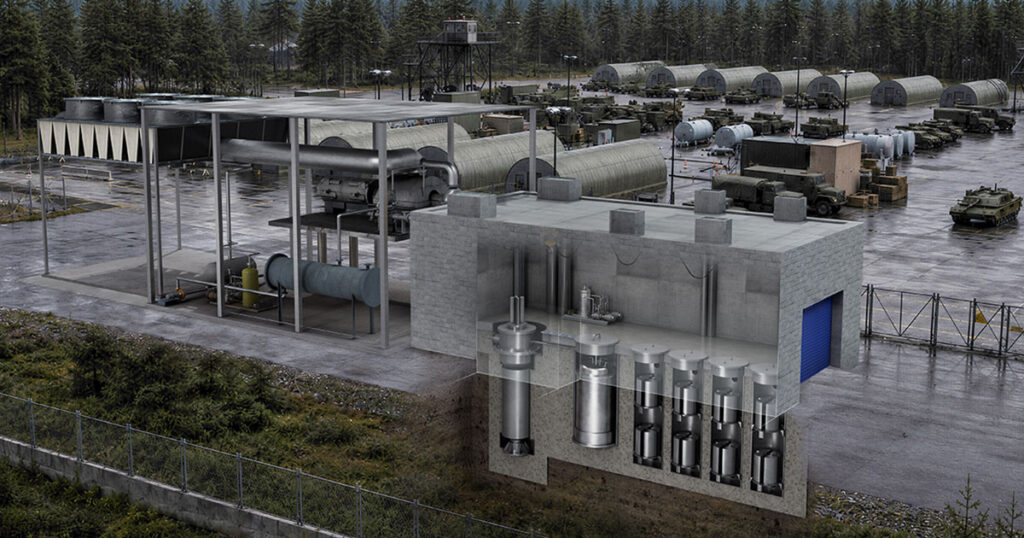
“The Janus Program is about transitioning from designs and experiments to reliable commercial hardware which secures our energy independence,” Waksman said. “The Janus Program vendors were selected through a deeply rigorous evaluation on technical, financial and organizational capabilities conducted by an all-star panel of dozens of experts from across the nation. We look forward to working alongside each team as they proceed toward successfully completing the rigorous technical milestones we’ve agreed upon.”
Nuclear Fuel and Waste
The Army said the selected reactors will not use highly enriched, weapons-grade uranium. The program is expected to rely on high-assay low-enriched uranium, or HALEU, with TRISO fuel identified as a likely option.
Fuel availability could become a constraint if the Army proceeds with its broader goal of deploying more than 20 reactors.
The Army also says nuclear waste will not be stored permanently at the installations. It is working with the Department of Energy on arrangements to remove spent fuel and other radiological material following reactor shutdown.
The reactors will be regulated by the Army rather than the Nuclear Regulatory Commission. Army officials say they are working with DOE and the NRC to align regulatory requirements as much as possible, potentially facilitating later commercial licensing of the technologies.
“When DOE created an authorization pathway for the demonstration of advanced reactor designs, we quickly began to realize how valuable these technologies could be for fortifying our national defense infrastructure,” said Assistant Secretary of Nuclear Energy Ted Garrish. “We are honored to work in lockstep with the Army to leverage nuclear energy innovation in support of our country’s military operations at home and abroad.”
Commercial Nuclear Ambitions
The Army’s broader objective is to use its initial military deployments to help nuclear developers move toward commercial-scale markets.
“The Janus Program will be a complete success when and only when we have assisted multiple nuclear companies in developing truly reliable and affordable nuclear microreactors which they can sell to other buyers beyond just the military,” Waksman said.
The Army also plans to work with utility providers on the Janus projects and future utility-scale, grid-facing generation located on military installations.
“The Army is leading the nation in its return to nuclear preeminence via the Janus Program,” said Jason Craft, Janus Program manager. “Our selected industry awardees represent the most viable technologies to achieve this capability, setting conditions for both installation energy resilience and operational energy solutions.”
The five initial projects are intended to establish whether advanced microreactors can provide reliable, resilient power for military infrastructure while helping build a domestic nuclear industry capable of supporting future defense and civilian demand.