

Chinese President Xi Jinping and Russian President Vladimir Putin reinforced their growing strategic partnership during high-level talks in Beijing on May 20, signing more than 40 cooperation agreements spanning energy, trade, technology, transport, and international affairs.
The summit came only days after U.S. President Donald Trump visited China, underscoring Beijing’s efforts to project itself as a major global power capable of balancing ties with multiple international actors.
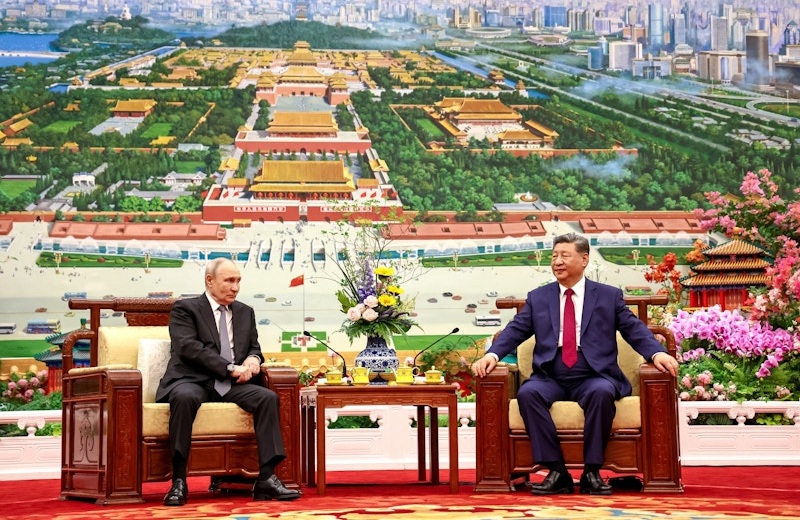
During the talks at Beijing’s Great Hall of the People, Xi and Putin emphasized the strength of bilateral ties, describing relations between the two countries as being at their strongest point in history.
“The countries’ ties have reached ‘the highest level in history,’” Xi said after the signing ceremony while addressing officials and journalists.
Putin echoed the sentiment, saying China and Russia’s cooperation in foreign policy was “one of the key stabilizing factors on the international stage.”
JUST IN: 🇷🇺🇨🇳 President Putin and President Xi Jinping officially sign joint agreement to expand Russia and China’s cooperation. pic.twitter.com/3njYwgBhX9
— BRICS News (@BRICSinfo) May 20, 2026
“In the current tense situation on the international stage, our close cooperation is particularly in demand,” Putin said.
The two leaders also agreed to extend the China-Russia Treaty of Good-Neighborliness and Friendly Cooperation, originally signed in 2001.
Energy Cooperation Takes Center Stage
Energy remained the dominant theme of the summit as Moscow and Beijing highlighted their expanding oil and natural gas trade amid global geopolitical instability.
Putin said “the driving force behind economic cooperation is Russian-Chinese collaboration in the energy sector.”
“Amid the crisis in the Middle East, Russia continues to maintain its role as a reliable supplier of resources, while China remains a responsible consumer of these resources,” Putin added, in an apparent reference to the ongoing U.S.-Iran conflict.
Xi stressed the importance of ending hostilities in the Middle East to preserve stability in global markets and supply chains. “An early end to the conflict will help reduce disruptions to energy supply stability, the smooth flow of industrial and supply chains, and international trade order,” Xi said, according to Chinese state media.
No Final Breakthrough on Power of Siberia 2
Despite the broad agreements reached during the summit, the two sides stopped short of finalizing details surrounding the long-discussed Power of Siberia 2 gas pipeline project.
The proposed 2,600-kilometer pipeline would transport up to 50 billion cubic meters of natural gas annually from Russia to China through Mongolia, potentially accounting for around 12% of China’s gas consumption based on 2025 estimates.
Kremlin officials said both sides had reached “a general understanding on the parameters” of the project, though unresolved issues, including pricing and timelines, remain under negotiation.
Russian presidential spokesman Dmitry Peskov said “some nuances remain to be ironed out” but confirmed that “an understanding already exists” regarding the pipeline route and construction framework.
While Xi referred to energy cooperation as a “stabilizing pillar” of bilateral ties, he did not specifically mention the pipeline during public remarks.
Denouncing Trump’s ‘Golden Dome’ and US Unilateralism
The geopolitical core of the summit crystallized in a lengthy, acerbic joint statement aimed squarely at Washington’s military dominance. Xi and Putin explicitly condemned President Trump’s multibillion-dollar “Golden Dome” missile defense initiative, a project featuring ground- and space-based interceptors.
“The parties believe that the US ‘Golden Dome’ project … poses a clear threat to strategic stability. These plans completely negate the key principle of maintaining strategic stability, which requires the inseparable interconnection of strategic offensive and strategic defensive weapons,” the two leaders declared in the statement issued via the Kremlin.
Beyond the missile shield, the joint declaration targeted Washington’s “irresponsible” nuclear arms control policy, criticizing the U.S. over the expiration of treaties restricting superpower arsenals. Xi leveraged the platform to repeat sharp criticisms of “unilateralism and hegemonism,” warning that the international order faces the acute danger of reverting to the “law of the jungle”.
Shifting to Sovereign Financial Subsystems
A critical operational takeaway from the bilateral talks was the near-total transition of Russia-China export-import operations away from Western financial networks. Putin disclosed that coordinated actions have successfully insulated billions in trade from external sanctions and European or American pressure.
Russia also confirmed its readiness to continue uninterrupted oil and gas exports to China. Putin noted that nearly all bilateral trade transactions are now conducted in rubles and yuan rather than Western currencies.
“The coordinated steps taken by Russia and China to shift settlements between them, between our countries as a whole, to national currencies have been of great significance,” Putin said. “As a result, virtually all Russian-Chinese export-import operations are being carried out in rubles and yuan.”
In tandem with currency shifts, the leaders agreed to further extend the landmark China-Russia Treaty of Good-Neighborliness and Friendly Cooperation, first signed in 2001. Xi asserted that this long-term alignment is a permanent strategic choice based on fundamental national interests rather than temporary geopolitical convenience. Looking ahead, the leaders finalized plans for deep collaborative integration, with Xi pledging to accelerate joint initiatives in artificial intelligence, technological innovation, and the digital economy.
Expanding Economic and Strategic Alignment
China became Russia’s largest trading partner after Moscow’s full-scale invasion of Ukraine in 2022. Despite maintaining that it is neutral in the conflict, Beijing has continued deepening trade and diplomatic ties with the Kremlin while resisting Western pressure to scale back cooperation.
Bilateral trade between the two countries reached approximately $228 billion in 2025, according to Chinese state media.
Xi said cooperation in trade, investment, technology, and people-to-people exchanges had continued to advance rapidly. “The China-Russia relationship has entered a new stage of greater achievements and faster development,” Xi said.
#VideoOfTheDay
— MFA Russia 🇷🇺 (@mfa_russia) May 20, 2026
🇷🇺🇨🇳 President of Russia Vladimir #Putin is welcomed by President of China Xi Jinping at an official ceremony ahead of bilateral talks.#WhereItsAt📍 Beijing, May 20, 2026#RussiaChina pic.twitter.com/EV9lrJmtU0
The leaders also pledged to accelerate cooperation in artificial intelligence, digital economy initiatives, scientific innovation, and transport connectivity.
Putin highlighted the impact of expanding travel links between the two countries, saying more than 2 million Russians visited China in 2025, while over 1 million Chinese citizens traveled to Russia.
Personal Diplomacy on display
The summit once again showcased the close personal rapport between Xi and Putin, who publicly referred to each other as longtime friends.
“My dear friend,” Putin said while greeting Xi at the beginning of the talks. “We are truly delighted to see you. We keep in constant touch, both personally and through our aides in the government.”
Xi addressed Putin as “my longtime friend” and stressed the importance of building upon “the foundation of mutual trust” between the two countries.
Following formal meetings, the two leaders reportedly held a private tea conversation at the Great Hall of the People before Putin departed Beijing later in the evening.
Analysts say the public display of unity serves both strategic and domestic political purposes as China and Russia seek to position themselves as counterweights to Western influence in an increasingly polarized global order.