

U.S. President Donald Trump and Chinese President Xi Jinping wrapped up a closely watched summit in Beijing this week with both sides signaling a desire to stabilize relations between the world’s two largest economies, even as sharp disagreements over Taiwan, trade, and global security remained unresolved.
Trump’s three-day visit, his second state visit to China and the first by a U.S. president in nearly nine years, was marked by elaborate ceremony, extensive discussions on Taiwan and Iran, and repeated public praise from the American president toward Xi. Yet despite optimistic rhetoric from both governments, the summit produced few concrete agreements.
Chinese officials described the meeting as the beginning of a new phase of “strategic stability” in bilateral relations, while Trump promoted prospective trade and investment deals that have yet to be formally confirmed.
A powerful arrival ceremony in Beijing. 🇺🇸🇨🇳 pic.twitter.com/kGedqmSwum
— The White House (@WhiteHouse) May 14, 2026
Key Takeaways
Here are the top takeaways from Trump’s trip to Beijing:
Taiwan remains a flashpoint
Taiwan emerged as the most sensitive issue during the summit, with Xi warning that mishandling the matter could destabilize U.S.-China relations and potentially trigger conflict.
“President Xi stressed to President Trump that the Taiwan question is the most important issue in China-US relations,” Chinese Foreign Ministry spokesperson Mao Ning wrote on X. “If it is handled properly, the bilateral relationship will enjoy overall stability. Otherwise, the two countries will have clashes and even conflicts, putting the entire relationship in great jeopardy.”
Mao added: “‘Taiwan independence’ and cross-Strait peace are as irreconcilable as fire and water.”
While Trump avoided publicly discussing Taiwan during his stay in Beijing, he addressed the issue aboard Air Force One on his return journey to Washington. Trump revealed that Xi strongly objected to U.S. military support for Taipei and acknowledged that the discussions may influence future arms transfers.
“President Xi and I talked a lot about Taiwan,” Trump told reporters. He said Xi “does not want to see a fight for independence because that would be a very strong confrontation.”
“I heard him out,” Trump said. But “I didn’t make a comment.”
Trump also suggested he had not yet decided whether to move forward with an $11 billion weapons package for Taiwan that his administration previously authorized. A separate $14 billion arms sale approved by lawmakers in January also remains pending formal transmission to Congress.
Asked whether the United States would militarily defend Taiwan in the event of a Chinese attack, Trump declined to give a direct answer, maintaining Washington’s longstanding policy of “strategic ambiguity.”
Secretary of State Marco Rubio sought to reassure allies that U.S. policy remained unchanged. “US policy on the issue of Taiwan is unchanged as of today and as of the meeting that we had here today,” Rubio said during an interview with NBC. “It was raised. They always raise it on their side. We always make clear our position and we move on to the other topics.”
Rubio also described any Chinese attempt to seize Taiwan by force as a “terrible mistake.”
Iran Conflict
Although trade and Taiwan dominated much of the attention surrounding the summit, discussions also focused heavily on the escalating conflict involving Iran and the broader stability of Middle Eastern energy routes.
Trump said both leaders agreed that Iran should not acquire nuclear weapons and emphasized the strategic importance of keeping the Strait of Hormuz open.
“We feel very similar about [how] we want it to end. We don’t want them to have a nuclear weapon. We want the straits open,” Trump said.
According to Trump, Xi also expressed willingness to help facilitate a resolution. “President Xi would like to see a deal made, he would, he would like to see a deal made. And he did offer. He said, ‘If I can be of any help at all, I would like to be of help,’” Trump told Fox News host Sean Hannity.
China has not publicly confirmed that offer, though Beijing has reiterated that any resolution should “take into account the concerns of all parties on the Iran nuclear issue.”
The issue is particularly significant for China, which relies heavily on energy imports passing through the Strait of Hormuz. Rubio later noted that Chinese officials were opposed to “militarizing the Straits of Hormuz” and rejected the idea of a tolling system.
Trade Deals Promised but Details Remain Scarce
Trump repeatedly promoted what he described as major upcoming trade agreements between the two countries, though few specifics were formally announced during the visit.
In an interview with Hannity, Trump claimed China had agreed to purchase large quantities of American soybeans and Boeing aircraft.
“China’s going to invest hundreds of billions of dollars with those people that were in that room today,” Trump said, referring to a delegation of major U.S. business leaders accompanying him to Beijing.
Trump also stated that China would order 200 Boeing jets.
“I sort of, I think it was a commitment. I mean, you know, it was sort of like a statement, but I think it was a commitment,” Trump added. “It’s a great thing. It’s a lot of jobs.”
However, Chinese officials have not confirmed the purchases. Trump suggested the agreement could eventually expand to include as many as 750 Boeing aircraft and hundreds of General Electric engines if initial deals proceed successfully.
The American delegation included high-profile executives such as Boeing representatives, Nvidia CEO Jensen Huang, Tesla and SpaceX chief Elon Musk, and Apple CEO Tim Cook.
Chinese Foreign Minister Wang Yi said both countries agreed to establish boards on trade and investment to address concerns surrounding agricultural market access and reciprocal tariff reductions.
Still, analysts cautioned that many details remain unresolved.
During Trump’s first presidential visit to China in 2017, the two governments announced agreements worth roughly $250 billion, though not all ultimately materialized.
Xi Pushes ‘Strategic Stability’ Framework
Chinese officials portrayed the summit as a turning point in bilateral relations, unveiling what Beijing called a “constructive China-U.S. relationship of strategic stability.”
The proposed framework would reportedly guide relations for the remainder of Trump’s term and focus on cooperation, controlled competition, and crisis management.
“The idea is ‘to keep the relationship on an even keel,’” said Helena Legarda of the Mercator Institute for China Studies in Berlin.
George Chen, a partner at The Asia Group consultancy, described the approach as a notable shift from the framing under former President Joe Biden, whose administration frequently emphasized strategic competition with China.
Personal Diplomacy and Symbolism Take Center Stage
Trump’s visit was also notable for the highly personal and ceremonial nature of the diplomacy.
From his arrival in Beijing, Xi orchestrated an elaborate welcome featuring military honors, schoolchildren waving American and Chinese flags, and a red-carpet reception at the Great Hall of the People.
The two leaders later toured the gardens at Zhongnanhai, the leadership compound in Beijing, where Trump admired the roses. “These are the most beautiful roses anyone’s ever seen,” Trump remarked.
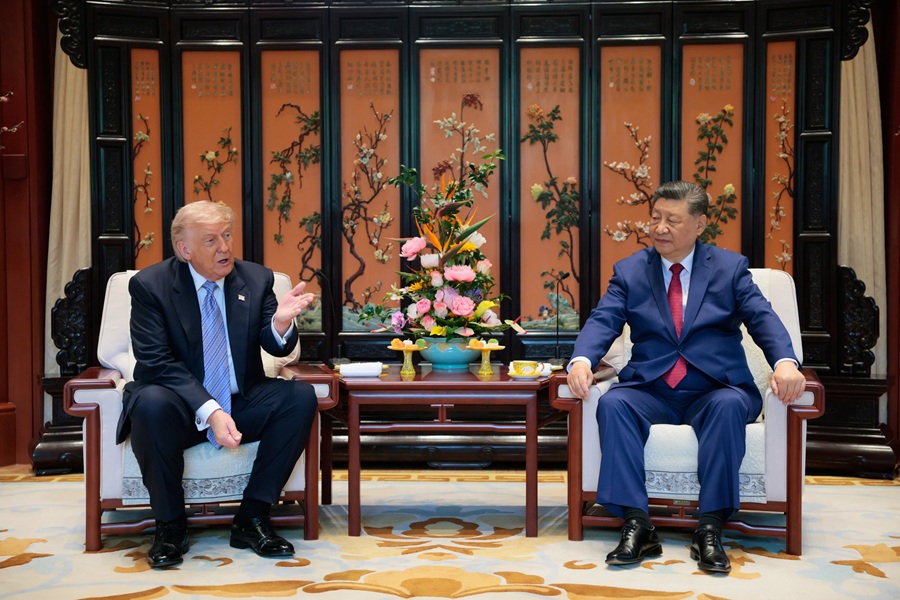
Xi responded by offering Chinese rose seeds to be planted in the White House Rose Garden, a gesture intended to symbolize goodwill between the two countries.
Xi said the invitation to Zhongnanhai reciprocated Trump’s hospitality during the Chinese leader’s visit to Mar-a-Lago in 2017.
Throughout the summit, Trump repeatedly praised Xi in unusually warm terms. Trump described Xi as a “great leader,” saying they would have a “fantastic future together,” while also calling it an “honor” to be Xi’s friend.
In his interview with Hannity, Trump offered one of his signature compliments about the Chinese president. “If you went to Hollywood and you looked for a leader of China to play a role in a movie…you couldn’t find a guy like him,” Trump said. “Even as his physical features, you know, he’s tall, very tall.”
Xi, by contrast, maintained a more restrained tone in public appearances, focusing largely on long-term state relations rather than personal rapport. “I think Xi is less effusive than Trump because he wants to be seen as having the upper hand,” said Dennis Wilder, a professor at Georgetown University and former adviser on China to President George W. Bush.
Still, Xi acknowledged that Trump’s “landmark visit” had strengthened mutual trust between the two nations.
Despite positive rhetoric and symbolic gestures, significant uncertainty remains surrounding the future of U.S.-China relations.
Taiwan continues to represent a major geopolitical flashpoint, while promised trade agreements remain largely undefined. At the same time, both governments appear eager to prevent tensions from escalating further amid growing instability in global markets and ongoing conflicts in the Middle East.
For now, the summit demonstrated that Washington and Beijing are seeking a more stable relationship but without resolving the fundamental disputes that continue to divide them.