

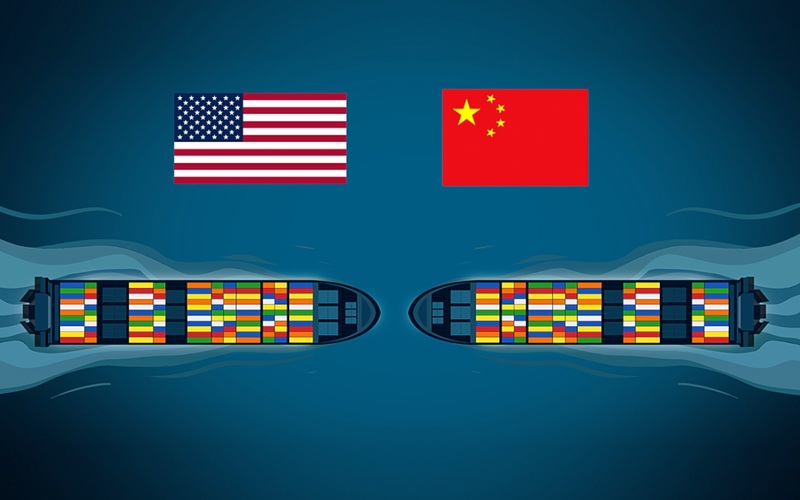
In a significant de-escalation of trade tensions, the United States and China have agreed to sharply reduce tariffs on each other’s goods for 90 days, temporarily halting a conflict that has disrupted global markets and strained the economic relationship between the world’s two largest economies.
The agreement, announced Monday after high-level negotiations in Geneva, will see U.S. tariffs on Chinese imports drop from a peak of 145% to 30%, while China will reduce its duties on American goods from 125% to 10%. The move marks the most substantial rollback in trade barriers since the dispute escalated more than a year ago.
Strategic retreat as economic pressures mount
The truce represents a notable shift for President Donald Trump, who has long touted aggressive tariffs as leverage in reshaping U.S. trade relationships. “We’re not looking to hurt China,” Trump said during remarks at the White House, adding that the talks would continue and that a full agreement would “take a while.”
Trump called the outcome a “total reset” in U.S.-China ties and emphasized China’s pledge to open its market to American companies. Yet the president also confirmed that certain punitive measures—particularly those related to China’s role in the U.S. fentanyl crisis—will remain in place.
A Temporary Pause, not a Full Resolution
Under the terms of the truce, both countries agreed to suspend newly imposed tariffs for three months. The joint statement issued Monday underscored a mutual desire to avoid a broader economic rupture.
“The consensus from both delegations is that neither side wants a decoupling,” said U.S. Treasury Secretary Scott Bessent, who led the American delegation in Geneva. “We concluded that we have a shared interest.” Bessent added that China would lift certain non-tariff retaliatory measures, including export restrictions on rare earth elements critical to U.S. manufacturing.
China’s Ministry of Commerce echoed those sentiments. “This move meets the expectations of producers and consumers in both countries, as well as the interests of both nations and the common interest of the world,” the ministry said in a statement.
Markets rally, but structural issues remain
Financial markets responded with relief. The S&P 500 closed up 3.2%, the Dow Jones Industrial Average gained 2.6%, and the Nasdaq Composite rose 4%, marking their strongest performances in months. China’s yuan surged to a six-month high, reflecting renewed investor confidence.
Still, analysts cautioned that the 90-day pause does little to address core issues: the U.S. trade deficit, intellectual property concerns, and Beijing’s regulatory environment. Sector-specific U.S. tariffs on steel, aluminum, and automobiles will remain in effect, and the 20% levy tied to fentanyl-related products will be unchanged.
“While the agreement eases immediate tensions, the structural divide between Washington and Beijing remains deep,” said Mei Li, senior fellow at the Asia Global Institute.
Critics call move a tactical concession
The administration’s sudden reversal drew criticism from trade hawks and policy analysts alike. “This is 100% a retreat by the U.S., not a Chinese cave,” said Scott Kennedy of the Center for Strategic and International Studies. “The Chinese retaliated and have only withdrawn those retaliatory measures, while the U.S. has pulled back significantly.”
Business groups, many of which had suspended operations or investment decisions due to trade uncertainty, welcomed the move but expressed a desire for a longer-term framework. Small businesses in particular have felt the brunt of rising import costs and supply disruptions.
Looking ahead
Both governments acknowledged that the truce represents only the beginning of a broader renegotiation. Bessent acknowledged that it will take years to fully recalibrate this trade relationship. Still, Chinese state media signaled a more conciliatory posture than in previous weeks. A commentary from the state broadcaster CCTV described the agreement as “a path toward expanded cooperation.”
With the 90-day window now open, the burden is on negotiators in Washington and Beijing to translate the temporary reprieve into durable progress. Whether the sides can move beyond tactical de-escalation to a more substantive rebalancing of economic ties remains uncertain.