

U.S. President Donald Trump has threatened to raise U.S. tariffs on Canadian cars, trucks and automotive parts to 50% from 25% beginning Jan. 1, 2027, escalating a trade confrontation with Ottawa after negotiations between the two countries collapsed late last week.
Trump also threatened to raise tariffs on Canadian steel to 50%, adding further pressure to an economic relationship already strained by a new round of U.S. duties and Canada’s decision to retaliate.
The latest threat could disrupt one of the world’s most integrated automotive supply chains. U.S. auto production relies heavily on Canadian-made vehicles and components, while Canadian manufacturers depend on access to the much larger U.S. market. Higher tariffs could increase production costs, disrupt cross-border manufacturing and raise prices for consumers.
The threat is separate from the 50% U.S. tariffs that took effect Aug. 22 on about $20 billion of selected Canadian exports. Those duties target products including wine, furniture, dairy products, cement, clothing, fishing rods and hockey equipment.
Proposed Deal Collapsed Over Auto Disputes
The U.S. and Canada had appeared close to an agreement before negotiations broke down late on Aug. 21.
The proposed deal would have cut U.S. tariffs on Canadian-built cars and light-duty trucks from 25% to 15% and reduced tariffs on Canadian steel and aluminum from 50% to 25%.
But the two sides remained divided over several issues, including the treatment of medium- and heavy-duty trucks.
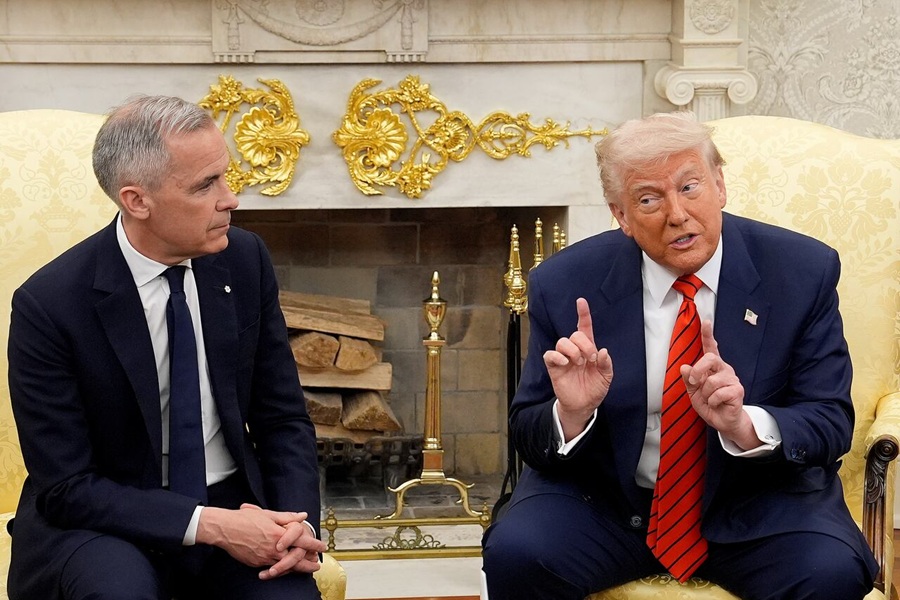
Three sources told Reuters that Canada wanted favorable tariff terms proposed for light-duty vehicles to extend to medium- and heavy-duty trucks, an approach the United States resisted. Canadian Prime Minister Mark Carney said the U.S. position would have excluded Canadian-made models including Ford’s F-350, F-450 and F-550 trucks and General Motors’ Silverado.
The disagreement was particularly important for Canada’s auto sector, where production is closely integrated with U.S. manufacturing.
Trump had briefly paused the planned new tariffs on Aug. 18 after saying the two countries had reached a deal, but the pause was extended for three days as negotiators continued working to resolve outstanding issues.
By Aug. 21, the negotiations had collapsed and the new U.S. tariffs went into effect.
Trump says ‘We Don’t Need Canada’
Trump said Canada could avoid the tariffs by moving production to the United States. “Build in the U.S. and there are ZERO TARIFFS. Canada will be treated like a State no longer!” Trump wrote in a social media post.
“On Trade, and in other ways, also, they are among the worst Nations in the World to deal with. They feel entitled, and yet, WE DON’T NEED CANADA, THEY NEED US!” Trump said.
Trump did not explain why the threatened auto tariffs would not take effect until Jan. 1, 2027. Industry executives told Reuters that the timing, coming after the November U.S. midterm elections, could indicate that the threat is also intended to bring Canada back to the negotiating table.
Canada Announces Dollar-for-Dollar Retaliation
Canada has responded to the latest U.S. tariffs with its own retaliatory measures.
Prime Minister Mark Carney said on Aug. 22 that Canada would impose tariffs on selected U.S. goods beginning Sept. 8. The measures will target U.S. steel, dairy, appliances, agricultural equipment, pulp and paper, electronics and other products. Ottawa said further details would be announced in the coming days.
“Canada will match Washington’s new tariffs dollar for dollar in order to protect Canadian workers, farmers, families, and businesses,” Carney told reporters.
Carney also used unusually forceful language to describe the dispute. “You’re at war when you get attacked. We got attacked,” Carney said when asked whether Canada was engaged in a trade war.
Canada’s retaliatory measures are scheduled to begin Sept. 8, while Trump’s newly threatened auto tariffs are scheduled for Jan. 1, 2027. The distinction is important: the 50% tariffs on the selected Canadian goods are already in effect, while the separate 50% auto and steel increase remains a future threat.
Ottawa Rejects US Terms
Carney blamed the collapse of negotiations on new U.S. demands introduced near the end of the talks.
“In recent days, the U.S. proposed new terms that were uneconomic, unfair, and undermined the net benefits to Canada, calling into question the reliability of any deal,” he said.
“We cannot accept what they have offered, and we will not give what they have asked,” Carney said.
Carney said some of the U.S. proposals affected Canadian culture, language and sovereignty. He also said Washington sought to curtail Canada’s ability to pursue new trade agreements.
U.S. Trade Representative Jamieson Greer offered a sharply different explanation, saying Canada was responsible for the failure to reach an agreement. “We progressed to a point Tuesday night where we had enough agreement among the parties to announce that we had … found the way to a deal,” Greer told CNBC’s “Squawk Box.”
“Then we set about to finalize it, and then in the last hours, I think there were things that the Canadians just — you know, they wanted more,” he said.
Greer said the United States had attempted to accommodate Canadian concerns by reducing tariffs in several sectors. The U.S. “sought to accommodate the Canadians” during the recent negotiations “by cutting tariffs in half on steel, on aluminum, and extensively reducing them on … autos, and even on things like like softwood lumber, accommodating some element of that.”
“Simply, they wanted more,” he said. “I don’t know if it was political for them. It certainly doesn’t make economic sense, but perhaps for political reasons,” Greer added. “I don’t know, but they came in and they wanted they wanted more, and we were prepared to do that.”
Greer separately said the breakdown was “a missed opportunity for Canada to partner with the United States.”
“We’re moving forward with measures that respond to Canadian retaliation,” Greer told Fox News. “They’ve always had the best deal, and they still would have an even better deal, but they didn’t want that.”
Auto Industry Braces for Higher Costs
The threatened tariffs have already weighed on automaker shares.
Ford shares fell 3.6% on Monday, while Stellantis declined 4.2% and General Motors fell 1.6%. Toyota shares were down 1.5% in New York trading and Honda shares dropped 2.1%.
Flavio Volpe, president of Canada’s Automotive Parts Manufacturers’ Association, warned that tariffs on Canadian components would directly affect U.S. assembly plants.
“A threatened U.S. tariff on Canadian auto parts will be paid by (the) US auto assembly. Without those specific parts, auto assembly throughout the U.S. would halt.”
The warning reflects the unusually integrated nature of North American vehicle production. Parts and vehicles routinely cross the U.S.-Canada border during the manufacturing process, meaning tariffs imposed on individual components can increase costs throughout the supply chain.
The dispute has already affected Canadian vehicle trade. According to the White House, Canadian imports of U.S. vehicles have fallen 22%.
New US Tariffs Cover 5% of Canadian Exports
The immediate U.S. tariffs that took effect Aug. 22 cover about $20 billion of Canadian exports, or roughly 5% of Canada’s exports to the United States.
The targeted products range from wine and dairy goods to furniture, cement, clothing, fishing rods and hockey equipment.
While the affected trade represents a relatively small portion of Canada’s overall exports to the United States, the impact could be severe for industries that have limited ability to absorb additional costs.
Softwood lumber and wine are among the sectors considered particularly vulnerable. Canadian business groups have warned that prolonged tariffs could lead to job losses and business closures.
Candace Laing, CEO of the Canadian Chamber of Commerce, said businesses were preparing for the consequences. “We will be mobilizing our network of businesses in all regions and all sectors to brace for impact and make the best of a bad situation,” she said.
Carney said Ottawa would announce support measures for industries affected by the new U.S. duties and that the measures could remain in place for years.
Canadian Political Support for Retaliation
Ontario Premier Doug Ford, one of the most vocal opponents of U.S. tariffs, backed Carney’s decision to reject the proposed agreement.
“I’m glad he didn’t sign that deal because it was a bad deal. It was a bad deal for Ontario. It was a bad deal for the auto sector, the steel sector, and manufacturing sector,” Ford told reporters.
Pierre Poilievre, leader of Canada’s official opposition Conservative Party, also called for a united response. “Canadians must stand united to defend our country against these unfair attacks on our jobs and businesses,” Poilievre said in a statement.
Carney has positioned himself as a tough negotiator with Washington and has pledged to reduce Canada’s dependence on the United States by expanding economic and security relationships elsewhere.

That is a difficult task given Canada’s dependence on the U.S. market. Nearly 70% of Canadian exports go to the United States, according to the Reuters report.
Trade Pact Faces Greater Uncertainty
The collapse of the talks also complicates the future of the United States-Mexico-Canada Agreement, the framework governing most North American trade.
The agreement remains in effect, but the latest confrontation adds uncertainty to its future as Washington and Ottawa negotiate separately over tariffs and broader trade arrangements. Reuters reported that the dispute could complicate the pact’s future, while the Trump administration has moved away from a long-term extension and toward annual reviews.
The economic stakes are substantial. U.S. goods and services trade with Canada totaled $872.3 billion last year, while Canada sends about three-quarters of its goods exports to the United States and imports almost half of its goods from its southern neighbor.
In the first half of 2026, the United States exported $175.8 billion in goods to Canada, making Canada the second-largest destination for U.S. exports after Mexico and accounting for 14% of total U.S. exports.
The Canadian dollar fell 0.41% against the U.S. dollar on Aug. 24 as markets assessed the latest escalation.
A New Phase in US-Canada Relations
The latest tariff threats mark another sharp deterioration in relations between two countries whose economies and security interests have traditionally been closely aligned.
For Washington, tariffs remain a central instrument for pressuring Ottawa to make concessions on trade and market access. For Canada, accepting U.S. demands risks exposing key industries to further pressure while undermining the government’s position that Canadian economic policy must remain under Ottawa’s control.
The immediate question is whether Trump’s Jan. 1 auto tariff threat becomes policy or serves as leverage for another round of negotiations.
For North America’s auto industry, however, uncertainty itself carries a cost. A manufacturing system built around decades of cross-border integration is now confronting the prospect of substantially higher barriers between the two countries on which it depends.
The dispute is therefore no longer limited to a narrow disagreement over tariff rates. It is becoming a broader test of the economic relationship underpinning North American trade.