

U.S. President Donald Trump has called for several Muslim-majority countries, including Saudi Arabia, Qatar, Pakistan, and Turkey, to join the Abraham Accords as part of any future agreement with Iran, adding a new dimension to ongoing negotiations aimed at ending the war with Iran.
In a social media post on May 25, Trump said negotiations with Iran were “proceeding nicely,” but insisted that broader regional participation in the U.S.-brokered normalization agreements with Israel should become a condition of any final settlement.
“I am mandatorily requesting that all Countries immediately sign the Abraham Accords, and that, if Iran signs its Agreement with me, as President of the United States of America, it would be an Honor to have them also be part of this unparalleled World Coalition,” Trump wrote on Truth Social.
The Abraham Accords were first signed in 2020 during Trump’s first administration, initially between Israel, the United Arab Emirates, and Bahrain. Morocco and Sudan later joined the agreements, which were presented as a framework for diplomatic, economic, and security cooperation between Israel and Arab states.
Trump Expands Pressure on Regional Powers
Trump said he discussed the proposal during calls held with leaders from Saudi Arabia, Qatar, Pakistan, Turkey, Egypt, Jordan, the UAE, and Bahrain.
While Bahrain and the UAE are already signatories, Trump argued that more countries should formally join the accords “simultaneously” as part of a broader regional settlement linked to Iran.
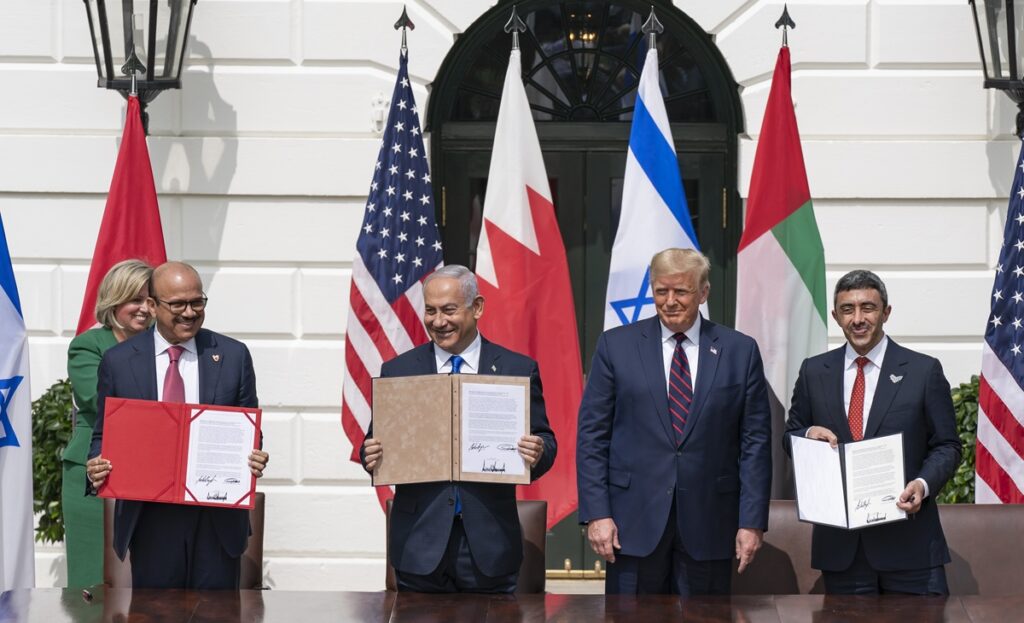
“After all the work done by the United States to try and pull this very complex puzzle together, it should be mandatory that all of these Countries, at a minimum, simultaneously, sign onto the Abraham Accords,” Trump wrote.
Trump also suggested that Iran itself could eventually join the agreements if negotiations succeed.
However, the proposal immediately faced skepticism from diplomats, analysts, and regional officials, many of whom warned that linking normalization with Israel to Iran peace talks could complicate already fragile negotiations.
Pakistan Rejects Proposal
Pakistan quickly distanced itself from Trump’s proposal. Pakistani Defense Minister Khawaja Asif said during an interview on Samaa TV: “In my personal view, I don’t think we’ll be part of any accords like this.”
“It would clash with our fundamental views. And I think no initiative like this has been taken from our side, nor as anyone approached us,” he added.
A Pakistani source familiar with the matter told Reuters that the Iran negotiations and the Abraham Accords were “not interlinked and cannot be made so.”
“Pakistan is under no compulsion to adhere to any such demand,” the source said.
Pakistan remains one of the lead mediators in the ongoing U.S.-Iran negotiations, while public support for the Palestinian cause remains strong across the country.
Saudi Arabia says normalization with Israel tied to Palestinian statehood
Saudi Arabia’s position on Palestine remains unchanged, with a Saudi source saying any regional deal must include a clear path towards statehood.
Speaking to Al Arabiya English, the source said “there needs to be an irreversible pathway to a Palestinian state”. The remarks come as US President Donald Trump told Muslim-majority countries to normalise ties with Israel in exchange for ending the war with Iran.
Gulf States Remain Cautious
Saudi Arabia and several Gulf states also appeared reluctant to embrace Trump’s proposal publicly.
Saudi Arabia has consistently maintained that it will not normalize relations with Israel without a credible pathway toward Palestinian statehood. The kingdom’s position has become even more sensitive following the Gaza war and growing regional instability.
A Gulf Arab official said the Saudi position had not changed.
“The Kingdom is supportive of all diplomatic efforts to resolve conflict, not military solutions,” the official said. “The kingdom also opposes all forms of aggression. Its position on the two-state solution being the only sensible way forward has not changed.”
Diplomats cited by Politico said many regional governments viewed Trump’s proposal as politically unrealistic and potentially damaging to peace efforts.
“It is a smart tactic to calm down the angry base,” a Gulf Arab diplomat said. “He will keep bringing it up again and again. But it will not be part of the deal.”
Another former U.S. official described reactions from Middle Eastern contacts as “disbelief and frustration,” while others privately referred to the proposal as a “poison pill.”
Analysts See Political Calculations Behind Proposal
Several analysts and former officials argued that Trump’s push to revive the Abraham Accords was partly aimed at reassuring Republican allies and Israeli supporters concerned that Washington may concede too much in negotiations with Iran.
Aaron David Miller, a former Middle East negotiator, told Middle East Eye: “Trump knows he’s getting a deal that undermines every war aim he espoused after 28 February. So, he’s trying to create a bigger deal.” Miller added: “This is a typical Trump ploy.”
Others suggested the move could also help Israeli Prime Minister Benjamin Netanyahu politically as Israel faces growing international criticism over the Gaza conflict and military operations across the region.
Ali Vaez, Iran project director at the International Crisis Group, said: “Trump is trying to sell an Iran deal as an Abraham Accords sequel: good for Israel, good for the region, tough enough for Washington.”
“But he is trading one fantasy for another – from forcing Iran to surrender to pretending a fragile deal can anchor a new Middle East order,” Vaez added.
Ceasefire Remains Fragile Amid New Military Strikes
Trump’s comments came as tensions continued despite an ongoing ceasefire between the United States, Israel, and Iran.
The U.S. military confirmed on May 25 that it carried out what it described as “self-defense” strikes in southern Iran targeting missile launch sites and boats allegedly placing naval mines.
Capt. Tim Hawkins, spokesman for U.S. Central Command, said the operations were conducted “to protect our troops from threats posed by Iranian forces,” while stressing that the military was “using restraint during the ongoing ceasefire.”
Iran has accused Washington of violating the truce, while uncertainty continues to surround the prospects for a long-term agreement.
Despite Trump’s optimism that talks are “proceeding nicely,” officials and analysts across the region warned that tying the Abraham Accords to the Iran negotiations risks further destabilizing an already volatile diplomatic process.