

Geneva became the focal point of global diplomacy on Tuesday as the United States launched two parallel negotiation tracks: indirect talks with Iran over its nuclear program and face-to-face discussions aimed at ending Russia’s war in Ukraine.
Convoys of diplomatic vehicles moved between the lakeside Cologny district and the InterContinental Hotel near the United Nations offices, underscoring the unusual concentration of high-level diplomacy in the Swiss city. While Geneva is accustomed to hosting sensitive international negotiations, simultaneous talks on two major security crises are rare.
The U.S. delegation, led by special envoy Steve Witkoff and Jared Kushner, President Donald Trump’s son-in-law, moved directly from the Iran discussions to the Ukraine negotiations with little pause, in what some analysts have described as an ambitious display of diplomatic multitasking.
Progress in Iranian Nuclear Talks
The negotiations regarding Iran’s nuclear program, mediated by Omani Foreign Minister Badr Albusaidi, concluded Tuesday with what officials described as a preliminary framework. Iranian Foreign Minister Abbas Araghchi announced that both sides had reached a “general understanding on a set of guiding principles” to move toward drafting a formal agreement.
“We now have a clear path ahead, which in my view is positive,” Araghchi told Iranian state television. However, he cautioned that a final deal was not imminent, noting, “This does not mean that we can reach an agreement quickly, but at least the path has begun.”
The atmosphere remains fraught with regional tension. While Araghchi characterized the talks as “more constructive” than previous rounds in Oman, Tehran continues to face the dual pressure of crippling economic sanctions and a massive U.S. military buildup in the region.
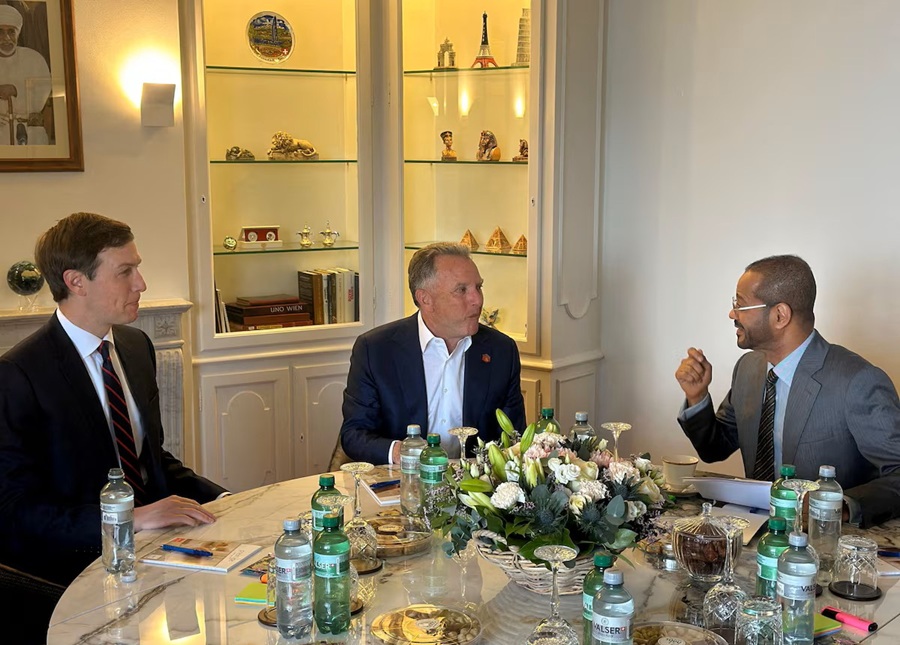
President Trump, speaking aboard Air Force One a day earlier, said he would be involved “indirectly” and described the negotiations as “very important.” He added that Iran wanted to make a deal.
Despite the progress on “guiding principles,” significant gaps remain. U.S. officials have indicated a desire to expand the scope of negotiations to include Iran’s ballistic missile program and its support for regional proxies, while Tehran maintains that discussions must remain strictly limited to nuclear constraints.
The Middle East remains on edge amid the possibility of U.S. military action should negotiations collapse. Trump has warned that Iran must reach an immediate accord or face a potential U.S. attack, and Washington has expanded its military presence near Iran as talks proceed.
Iran has insisted that discussions be strictly limited to its nuclear program, while U.S. officials have indicated they will push to curb Tehran’s ballistic missile capabilities and its support for militias across the region.
Ukraine-Russia Peace Process
As the Iranian motorcade departed, U.S. delegates transitioned to the Intercontinental Hotel, a frequent venue for sensitive diplomatic meetings near the United Nations offices in Geneva, to begin the first of two scheduled days of negotiations between Ukrainian and Russian representatives. The talks were focused on ending Russia’s nearly four-year war.
Reporters and camera crews gathered outside the hotel early Tuesday in hopes of glimpsing the arrivals. Around 200 demonstrators assembled outside the UN office in Geneva to denounce Iran’s protest crackdown, later replaced by roughly 100 pro-Ukraine activists carrying banners reading “Save Ukraine to preserve peace in Europe.”
The U.S. delegation included U.S. special envoy Steve Witkoff and Trump’s son-in-law Jared Kushner. Their dual role in the Iran and Ukraine tracks has drawn scrutiny from foreign policy observers who question whether the administration risks overextension by attempting to advance two complex negotiations simultaneously.
Russian President Vladimir Putin’s delegation in Geneva is led by Vladimir Medinsky, a former culture minister who has previously headed Russian talks. Kirill Dmitriev, chief executive of Russia’s sovereign wealth fund, is expected to meet separately with Witkoff and Kushner.
The Ukraine talks face entrenched positions. Kyiv has long sought security guarantees and territorial integrity, while Moscow continues to press demands that critics say would entrench its military gains and constrain Ukraine’s future defense posture.
President Trump had pledged during the 2024 campaign to end the war swiftly. The Geneva negotiations represent the most recent effort to translate that commitment into a structured diplomatic process.
Multitasking Diplomacy under Scrutiny
The decision to assign the same senior envoys to both negotiations has drawn attention in foreign policy circles. Observers question whether managing two high-stakes processes simultaneously risks overextension.
Even so, the Geneva meetings reflect a strategic calculation in Washington that momentum in diplomacy can be leveraged across theaters. In the Iran case, there appears to be convergence around avoiding military escalation, even if disagreements remain over scope and sequencing. In Ukraine, the path to settlement remains far less defined.
For Geneva, the convergence of these negotiations reinforces its role as neutral ground for crisis diplomacy. For the United States and its counterparts, the outcome of these parallel tracks could reshape the security architecture of the Middle East and Europe.
Whether the agreements under discussion can withstand political pressures in Washington, Tehran, Moscow, and Kyiv remains uncertain. What is clear is that, for now, Geneva has become the staging ground for two of the most consequential diplomatic efforts of the year.