

Brent crude surged above $108 a barrel on Sept. 14 as an attack on a merchant vessel in the Strait of Hormuz and the shutdown of Saudi Arabia’s key East-West Pipeline intensified concerns that critical Middle East energy routes are becoming increasingly vulnerable.
Brent futures climbed more than 3% to $108.49 a barrel in Asian trading, while U.S. West Texas Intermediate reached $106.60 before easing. Both benchmarks extended last week’s gains after moving back above the $100 threshold.
The latest rally came after Saudi Arabia closed its East-West Pipeline following drone attacks and a merchant vessel was struck in the Strait of Hormuz on Sept. 13, killing one crew member and injuring three others, according to Iranian authorities.
The combination has sharpened concerns about the availability and transportability of crude at a time when global inventories are already under pressure.
Saudi Pipeline Shutdown Removes Critical Alternative Route
Saudi Arabia’s 1,200-kilometer East-West Pipeline runs across the kingdom from Gulf production areas to Red Sea ports, allowing crude to reach international markets without passing through the Strait of Hormuz.
The pipeline has a total capacity of up to 7 million barrels per day and has been carrying roughly 5 million barrels per day, according to market analysis cited by Saxo Bank.
Two regional officials briefed on the damage told The Associated Press on Sept. 14 that repairs could take three to five weeks, including work at a major pumping facility. One official said the pipeline could operate partially while repairs continue.
The Saudi government has blamed the Sept. 10 attacks on Iran-backed militias based in Iraq. Saudi Arabia’s Energy Ministry said the pipeline was shut as a precaution after multiple attacks and that several people were injured.
Satellite imagery released after the strikes showed extensive fire damage at a pumping station connected to the pipeline.
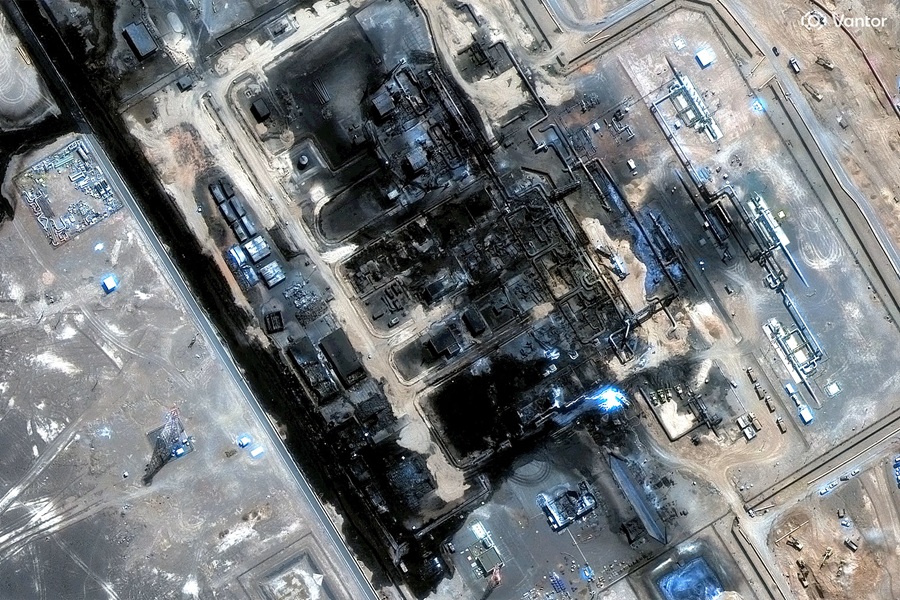
Saxo Bank warned that the shutdown could place around 4% of global oil supply at risk and potentially force Saudi Arabia to reduce production if storage facilities become full.
“With no end to the conflict in sight, the risk of further inflationary pressure through higher fuel costs remains a key focus,” Saxo Bank said.
The bank also pointed to sharply higher premiums for immediate crude deliveries. “In Brent, the prompt month spread has jumped to $5.39 while the three-month spread has surged to near $14 highlighting the elevated premiums buyers are prepared to pay for immediate delivery,” it added.
Hormuz Disruption Raises Shipping Risks
The Strait of Hormuz remains the central concern for energy markets because of its role as a major route for global oil and fuel shipments.
The latest vessel attack has added another layer of risk for commercial shipping, with maritime operators facing greater uncertainty over whether vessels can safely transit the waterway.
Waleed Said, a technical analyst at GivTrade, said the market was being driven less by conventional demand changes than by concerns over physical supply.
“Both Bent and WTI advanced more than three percent as renewed attacks disrupted critical Middle East energy infrastructure and shipping routes,” Said said.
“A major Saudi pipeline capable of bypassing the Strait of Hormuz has been shut, placing roughly four of global supply at potential risk while shipping through Hormuz remains heavily constrained,” he added.
Said said this was keeping an unusually large geopolitical premium embedded in crude prices even as tighter monetary conditions threaten global demand.
Yemen Opens Another Front for Energy Markets
The oil-market pressure is also unfolding alongside a renewed escalation in Yemen.
Iran-backed Houthi rebels seized the strategic Greater and Lesser Hanish islands, according to Yemeni government and Houthi officials. The islands sit roughly 160 kilometers north of the Bab el-Mandeb Strait, another critical maritime chokepoint connecting the Red Sea with the open ocean.
The Houthis have also seized the port city of Mokha and the island of Mayun, strengthening their position along routes used by Saudi Arabia to reach major Asian markets.
The developments have increased pressure on Saudi Arabia, which is simultaneously dealing with attacks on its energy infrastructure and continued cross-border threats from Yemen.
The United Nations estimates that more than 80,000 people have been displaced in Yemen over the past two weeks. The escalation has raised concerns that the country could slide back into a broader civil war after years of relative calm.
Global Fuel Markets Already Under Pressure
The disruption comes as refined fuel markets are showing signs of acute tightness.
U.S. diesel prices crossed $6 a gallon on Sept. 11 for the first time, according to the supplied market data, while gasoline prices have also reached record levels.
BMI analysts at Fitch Solutions said diesel cracks were reaching record highs in Europe and the United States, with U.S. diesel prices rising above $200 a barrel on Sept. 9 and raising concerns about fuel shortages in the next quarter.
The analysts said tanker-tracking data indicated August flows of roughly 15 million barrels per day of crude and fuels, around two-thirds of the estimated 25 million barrels per day pre-conflict level.

Russian seaborne crude exports have also fallen by about 1.2 million barrels per day from late-June peaks, further reducing available supply.
Inflation Creates a Second Risk
The oil shock is occurring alongside renewed inflation concerns in the United States.
Said noted that August headline consumer prices increased 0.4% month over month and 3.4% year over year, while core CPI rose 0.3% month over month and 2.4% year over year.
“Those actual figures have strengthened expectations for a 25-basis-point interest-rate increase this week, with market-implied probability around 86 percent,” he said.
Higher crude and diesel prices could reinforce inflation, potentially prompting tighter monetary policy and weakening economic activity.
“That is why oil can rally sharply on supply disruption while still carrying a growing medium-term demand-destruction risk,” Said noted.
Limited Spare Capacity Leaves Markets Exposed
OPEC+ is also providing little immediate relief. According to Said, the group’s latest position of holding October required production at September levels provides no immediate additional supply cushion.
Global supply projections point to roughly 100.7 million barrels per day in 2026, down 5.7 million barrels per day from the previous year, while observed inventories have fallen by about 507 million barrels since February.
BMI said the physical market was already signaling acute tightness, with regional benchmarks Murban and Oman trading above Dated Brent and the futures curve showing deeper backwardation.
The firm maintained its forecast for Dated Brent to average $86 a barrel in 2026 and $71 a barrel in 2027, but warned that the risks are increasingly tilted higher.
“Offsetting levers are thinning, with inventories depleted, spare capacity stretched, and Asian refinery runs recovering from Q2 lows,” BMI analysts said.
They added that the company could make a “sizable upward revision” to its forecast if diplomatic efforts fail.
For oil traders, the immediate question is whether the damage to Saudi infrastructure, disruption in Hormuz and escalating fighting around the Red Sea remain temporary shocks or become a broader and sustained threat to global energy flows.